
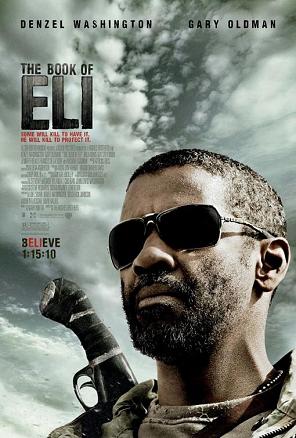
 The Book of Eli is rated R for adult content, profanity, images of rape, and excessive violence. It also, rather startlingly, has an overt, fairly profound Christian theme.
So is the Book of Eli a “Christian film”?
That question — and the film — illustrates the ambiguity of the concept of “Christian” anything. Especially Christian art.
Many of the reviewers of the film illustrate the conundrum Christians have created for themselves. On the one hand, we demand clear biblical themes and references. The Book of Eli has these. But on the other hand, we demand sanitized, family friendly fare. And this is where the film falls short. Way short.
During its pre-screening, one reviewer noted that “‘The Book of Eli’ contains just as much (if not more) Christian imagery as ‘The Chronicles of Narnia.'” Nevertheless they asked, Will Christian Audience’s Embrace Denzel’s ‘Book of Eli’?
“I’m really going to be interested to see how this movie plays with Christians,” says Paul Asay, associate editor of Focus on the Family’s Plugged In, an entertainment site for evangelical Christians. “My guess is that evangelical leaders will have a difficult time fully embracing the film, but a lot of actual evangelicals will go.”
The question was, “Will true believers rally around a violent, hard-R movie like ‘The Book of Eli’ — even if it heavily promotes Christian themes?”
New York Post film critic Kyle Smith, in his review Onward Christian Soldier, the film as an “overtly, unabashedly Christian one.”
“The Book of Eli” is not only a well-done action picture but an overtly, unabashedly Christian one in which Denzel Washington plays a soldier of God. He’s on a divinely-inspired quest — yes, a literal mission from God — to take The Book to the West as a swarm of wrongdoers led by Gary Oldman try to stop him.
But even though Smith would go on to call ‘The Book of Eli’ a “Christian blockbuster,” the problem is the film’s excessive gore, dismemberment, rape, blood splatter, and the standard R-rated language. Both body count and cussword count have kept believers from going “all in” on “Eli.”
In fact, not everyone was thrilled about meshing violence with the film’s religious content, leading one columnist ask, Is the Book of Eli anti-Christian?
Devout filmgoers will soon realize that “the brand of Christianity on display in ‘Eli’ is as warped as they come,” says S.E. Cupp in the New York Daily News. Washington’s character is a “crusader” who defends the Bible by “beheading, stabbing, shooting and head-butting” anyone who gets in his way. Only “violent, fundamentalist” Christians will relate to this “Hollywood caricature.” (bold mine)
In i09’s interview with the Hughes brothers, the directors admitted reluctance about “the religious stuff or the spiritual stuff” in the script, and were concerned to make sure the film did not come off as “preachy.” But when the interviewer suggests that Eli “walks the line of being an evangelical film,” the directors downplayed any connection. It was Denzel Washington, a professing Christian, who sold the story. One Christian review site even described Washington as “protecting” the film the same way his character protected the Book.
“Denzel by nature is a very religious, spiritual man,” said [Director] Albert Hughes, “and he makes no secret of that. He brought all that to the project and helped us with it, because we’re not exactly the most dedicated Bible readers in the world.”
“I spent a lot of time going through the Bible to find passages that Eli could quote at appropriate moments,” said screenwriter Gary Whitta. “Denzel found a bunch as well because he’s a Christian man. He’d come into script meetings with the script on one hand and the Bible in the other. He found all these parallels, and had Post-it™ notes all over the place because he’d been up all night finding these things.”
Apparently, the script and the passion Denzel Washington brought to the project, left a mark on the directors.
“There’s a scene where Gary Oldman’s character makes a statement that the Bible isn’t just a book, it’s a weapon, and that made me go ‘Whoa!'” said Allen Hughes. “The whole movie leading up to that point had Eli reciting Scripture, and you knew he was a man of the Bible, a man of faith. But when you hear this other character say that, I thought, ‘This is deep. It’s about something, and not just blowing stuff up.'”
Still, it’s hard to get past all the “blowing stuff up.”
And that’s the dilemma many Christian filmgoers seem to have with “Eli.” The Associated Baptist Press review of the film uses this Christian reviewer as an example:
The movie’s hard edge may give some religious moviegoers pause. Angela Walker, director of producer relations for ChristianCinema.com, wrote that she pondered the movie’s objectionable content for a month after seeing an advance screening before deciding the film’s spiritual themes were redeeming qualities.
“Personally, I want to support filmmakers who explore questions of faith in their films,” she wrote. “For me, choosing to see this film is casting a vote for Hollywood filmmakers to keep making films about faith. It is telling them I will buy tickets to films they create about topics I’m interested in.”
I concur with Ms. Walker’s conclusion.
When I first saw The Book of Eli, I liked it. Only mildly. I thought the violence was way too excessive. But the twist ending and the biblical theme won me over. Plus, “I [too] want to support filmmakers who explore questions of faith in their films.”
So is “The Book of Eli” a “Christian film?”
While Focus on the Family’s Plugged In review counts cusswords —
More than a dozen f-words and half-a-dozen s-words. God’s name is paired with “d??n.” “B??ch,” “b??tard” and “h???” are said.
the reviewer is forced to concede:
The Book of Eli is, perhaps, the most explicitly Christian film I’ve seen come out of the secular film industry since The Passion of the Christ. Indeed, it’s something of a Sunday sermon wrapped in a Mad Max adventure.
Does the violence eradicate Eli’s message? No.
Does the message redeem Eli’s violence? No.
This, then, is a spiritual tale told through the prism of a dystopian Western; a religious story shellacked with gore.
Even the ultra-conservative Ted Baehr and his Movieguide seems to capitulate:
THE BOOK OF ELI is very captivating, awe-inspiring, and ultimately uplifting, with excellent production standards and absorbing character portrayals. The movie’s blatant support of Christianity and the overt references to the Bible are greatly encouraging and very surprising. Throughout the story, Eli prays, teaches others to pray, quotes Scripture, and walks by faith in God. Regrettably, extreme caution is advised for the movie’s excessive amount of extreme, brutal violence, some scenes of implied, attempted rape, and unnecessary foul language.
Apparently, as long as a film or book contains “blatant support of Christianity” and “overt references to the Bible,” body count and cussword count are excusable.
Really?
Whatever you conclude, “The Book of Eli” may be the perfect example of the dilemma consumers of evangelical pop culture have created for ourselves.







Comments on this entry are closed.
Hey, if the prophet Elijah can behead the 400 prophets of Baal in the Bible, why do we freak out if we see it in a modern film?
Here’s where we get into the difference between our mind’s imagination and the visual medium. Keep in mind, I have not see this film. But which would be have more impact on the modern American Christian: reading a single line in the Bible that says Elijah kills the prophets, or seeing a guy cut off body parts with copious amounts of blood and gore? I don’t think the two are a valid comparison. I would have no problem reading Elijah’s actions to my 11 year old son; it’s another thing entirely to let him watch an episode of The Walking Dead.
I concur with Mike: “Book of Eli” sounds like the perfect example of an evangelical pop culture dilemma.
I think you’re missing the point, Steve. The Bible is an historical account. The beheadings actually happened. People witnessed them. The violence was deemed necessary. By contrast, fake violence in a film is much, much tamer because real heads aren’t actually being detached from real bodies.
Yes, violence in the Bible is real. I understand that. I don’t gloss over it when I read it, nor do I try to wave it away when I explain the Scripture reading to my boys. But you’re telling me watching the fake violence in a movie, in all its gory glory, is “tamer” than reading a sentence of printed text that says 400 people were beheaded? Have you seen the gore on “The Walking Dead”? I know it’s not real. Yet I would put money down that watching an episode of that late at night would result in troubled sleep, versus reading “Then David ran over and pulled Goliath’s sword from its sheath. David used it to kill him and cut off his head.” (1 Samuel 17:51)
No, I’m not saying that movie violence is tamer than a short written text. I’m saying that it’s tamer than the actual, real-life violence brought about by a prophet of God. You’re looking at it exactly backwards. The event didn’t occur so that there could be a short portion of Scripture written about it. It was written about because the event, itself, happened and was an important part of the history of God’s people. It didn’t simply occur in words; it happened in reality. By contrast, movie violence is a simulation of real violence. It exists in movies because movies depict the human condition, and, as we know from history (including the Bible) violence is part of the human condition.
Since some of Jesus’ Parables contain people receiving death for their actions to illustrate the nature of the Kingdom of Heaven, It would be reasonable to for Christians to employ similar mechanisms in storytelling.
To *not* do so would be to ignore an important part of Christ’s public ministry…
One huge issue I had was the very end…where the Bible was placed (right next to the Koran). Seemed to indictate they were both on the same footing of truth, to me. Made me feel a bit empty, like the end of “Life of Pi.”
I’m glad I’m not the only one who felt that way about Life of Pi. Everyone raved so much about that movie, and I felt like the end was a giant let-down.
The END? The entire movie was egregious pap, IMO.
^Yes! 🙂 My observation exactly!!
This film has Christian elements but is not a Christian film. So what? It’s about what a Christian superhero looks like to curious, even respectful non-Christian filmmakers. It’s very cool and I liked it a lot (while admitting it had deep flaws). It’s one step removed and that’s close enough to make this interesting if not exactly something I claim as one of our own. I wish more films examined faith in this way.
There is a very simple and biblical standard for this kinda stuff. FIRST, FIRST FIRST. That means before and governing everything else. I insist upon the SCRIPTURE’S standards of godliness in thought, deed and word. I then ask myself, is there anything in this movie (or anything else), that my performing or producing or my family’s performing or producing would be sin according to the SCRIPTURES?
If so, then it would be the diametric opposite of loving my neighbor as myself to promote and finance the sin of others I am supposed to be a testifying witness of the transforming gospel of Christ to.
According to the SCRIPTURE’S , would God want my wife or children to speak, think or act like the IMDB content ratings tell me the people who made this movie thought spoke and acted like.
If I am willing to call blasphemous, profane speech, nudity and sexual contact off limits for myself and my wife and children, BUT am willing to pay sinners to do it for me, then no plainer example of hypocrisy could possibly exist.
If I AM willing to see my wife and or children “perform” such sinful acts and speech in front of a film crew so millions can watch them on a 3 story movie screen, then I need to get saved. At Dr. DG Hart’s blog, I had someone one tell me this very recently. That he would be willing to watch a married Etan Hawke sexually handle and deeply kiss his own covenant wife on the altar of Hollywood rather than declare such filth the abomination that it is. At least he’s consistent. Dr. Hart himself said almost the same thing. I can link that if necessary, but didn’t know how you’d feel about it.
All this only matters to people for whom the SCRIPTURES are FIRST, FIRST FIRST. Until my (and all of historic protestant orthodoxy’s) long standing and ever ignored challenge to demonstrate otherwise from the SCRIPTURES is answered, this is universally binding and applies to every person who claims the name the Jesus. Of course this instantly eliminates 99.9% of movies AND say 90% of people claiming to be Christians. Both of which are EXACTLY what I’m told to expect in the SCRIPTURES.
Mike linked to Jeff Overstreet’s glowing review of that demonic flesh festival “Wolf of Wall Street”. There we found thousands of words from the that God hating pagan Martin Scrosesee and exactly NO SCRIPTURE
If Denzel Washington or Jeffery Overstreet are Christians, I’ll throw my bible away and become a Hindu or something. The book has no meaning.
There will likely be some very VERY tired and predictable mushy modernist responses here. DO feel free, but I promise. You will be telling me everything I’ve heard a thousand times already. Mike, whatever happens here you are a standup guy for at least not censoring anachronistic, antique nutcases like me. I honestly respect that.
LOL, Greg, you continue to be funny no matter which site on the Internet I find you on.
Well thank you so much for this tremendously substantive answer. I’m getting quite used to them. 😀
Let me use an analogy to why this will not work, Greg.
Imagine you are a new believer. Imagine if you meet someone who welcomes you to a church, but then says “You are only allowed to eat bread and drink water, or you’re not a Christian. 99% of the secular markets produce nothing but fattening filth, and 90% of the people who eat from there aren’t Christians.” Now I want you to imagine that for the rest of your life, you need to do this and live under this.
This is what your words feel like to people who consume the arts.
The desire to read, to watch, to create, and to consume art is a part of being human. There is a legitimate place to worry about how art affects us, and whether or not we are eating things bad for us and that can even kill us over time if left unchecked. The proper amount of nutrition to keep healthy has to be balanced with enjoyment in eating, because life sucks when we deny one aspect of the two. But you’re really talking about being so against everything that it’s like just eating bread and drinking water.
Yeah, the Bible, but that’s also like saying to a person that complains about the menu that he should exercise more and he won’t mind. People simply cannot deny the aspect of humanity that enjoys art for its own sake, and it can’t be ignored, only offered up to Christ and the balance found for each individual believer.
Have patience. I’ll get to all this. Like I say. Nothing new. I’m not tryng to a be a jerk, but this is yawn inducing repetitive argumentation here. I’ll give ya credit for tryin. It’s more than I get from most.
Your whole diatribe has been said so many times by so many people that I find it yawn-inducing, too. So at least everybody’s getting some good yawns.
But SCRIPTURE!
If Denzel Washington or Jeffery Overstreet are Christians, I’ll throw my bible away and become a Hindu or something. The book has no meaning.
I’ve read many articles and interviews with Denzel over the years. I’ve never gotten the impression he’s anything but what he claims to be, a Christian man who is also an actor. If your faith is predicated on your perception of public figures who don’t behave as you prefer, you’re doing it wrong. (I realize you were being melodramatic to make a point. I’d rather give Washington the benefit of the doubt than impugn his identity as a fellow brother in Christ based on your distaste for his roles or whatever.)
Greg, where I would take most exception with you, believe it or not, is this statement: “If Denzel Washington or Jeffery Overstreet are Christians, I’ll throw my bible away and become a Hindu or something. The book has no meaning.”
Do you really know these men well enough to say this? Are you SO certain of your position on this issue, and your discernment of these two men, that you would bank your salvation on that accuracy?
While I respect that everyone has differences of opinions about Christianity and culture, and its various intersections, I don’t think any of us are in a position to make such cut-and-dried judgments. God alone knows the human heart. The New Testament is shockingly clear that some people who “appear” to deserve heaven, won’t go there. And some who “appear” to deserve hell, will go to heaven. Disagree vigorously with people. Go for it. But unless you’re able to see someone’s heart, know their thoughts, understand the complexities of their history, and perfectly embody the grace and truth of Christ, I think we should refrain from making such over-the-top indictments of others.
I like you Mike and as I say, no matter how wrong we may actually eventually get with each other (or maybe not) I will always have respect for you. I mean that. This is a fair comment to which you will get my best fair response as soon as I can. 1st John 3 figures heavily. I will give some more clarity as to what I mean. Thank you for your gracious indulgence btw. I mean that too.
From HERE
Mike says: “Greg, where I would take most exception with you,”
Where else do you take exception with me Mike? Can I respectfully ask for some scripture with an interpretation that’s more than 15 minutes old? I don’t really know you so I’m not assuming. Or trying not to anyway. Forgetting about Washington or Overstreet for the moment. Why is my standard not biblical.
Mike quotes me as saying: “believe it or not, is this statement: “If Denzel Washington or Jeffery Overstreet are Christians, I’ll throw my bible away and become a Hindu or something. The book has no meaning.”
And then responds with the following:
Do you really know these men well enough to say this? Are you SO certain of your position on this issue, and your discernment of these two men, that you would bank your salvation on that accuracy?
I have no idea who the elect are. I would burn myself at the stake before EVER declaring anyone’s eternal destiny. That is the purview of God alone. What I am COMMANDED to do, and so is EVERY Christian, is make sound judgements on the reliability of someone’s present testimony. There are a variety of factors involved in this. I do not tell people that Jeff Overstreet WILL go to hell. I tell them if you want to know what a Christian looks like by actually SCRIPTURAL standards, then pick somebody else.
Honestly, this is a sidetrack I regret. I’m sorry I brought it up in this context. As I said before. Still a WORK in progress. Romans 14 and a couple other passages I still haven’t gotten to. Originally was to a specific person a few years ago. Check that for some more for now please.
I ask that we forget the judging thing for now and although this is certainly not my place and I’m no position to demand, can I ask that you address where you disagree with the biblical standard I have declared here as universally binding according to the Word of God for all people for all time? Where am I wrong?
Greg, I’m glad you’re stepping back from “declaring anyone’s eternal destiny.” However, your statement, ““If Denzel Washington or Jeffery Overstreet are Christians, I’ll throw my bible away and become a Hindu or something,” insinuates as much. It may be a “sidetrack,” but it’s consistent with the strident tone you seem to bring to this discussion.
Many of the commenters here share my basic disagreements with you, so I don’t want to rehash things that have already been said. I’ll just point out this one basic disagreement we have.
It would be the arbitrary condemnation of Hollywood. You wrote below, in response to Johne, “Hollywood is a reprehensible, morally and spiritually decomposing filth factory. How ANYbody claiming a relationship with the spotlessly holy risen Christ of God can also maintain a relationship with one of his most successful enemies is truly incredible.” While I’d agree that there’s much about Hollywood that is “filth,” there are also many professing Christians at work in Hollywood, to change it and to be a light in the darkness. You admitted above that it’s not our place to judge “anyone’s eternal destiny.” So don’t you think it’s wise to refrain from similar blanket judgments of an industry and all the individuals therein?
I think one Scripture that applies to this is The Parable of the Tares and the Wheat in Matthew 13:24-30. (Jesus went on the explain the parable in vss. 36-43.) The parable clearly teaches that counterfeits are everywhere. Satan “sows” false Christians among true Christians. We’d probably be in agreement about this. But the teaching of the parable turns when the landowner instructs his servants to NOT uproot the tares, but to let them grow (vss. 28-30), for in so doing, they might uproot the wheat. Rather, they should wait for the “harvest” when everything will be shaken out. While I agree that we should be discerning and “make sound judgements on the reliability of someone’s present testimony,” passing judgement (i.e., uprooting tares) must ultimately be left up to God.
One of the major flaws in your approach, I think, is one of guilt by association. You label something as “unholy” or “worldly” and then proceed to condemn anyone who associates with said thing. It’s very much similar to the “meat sacrificed to idols” controversy among first century Christians (I Cor. 8). Some “weaker” Christians saw the meat sacrificed to idols as defiled. And thus, Christians who partook of meat sacrificed to idols were also defiled. Paul clearly rebuts this saying, “food does not bring us near to God; we are no worse if we do not eat, and no better if we do” (vs. 8). It’s similar to Paul’s train of thought in Romans 14 regarding Christian liberty. Some feel they should abstain from certain foods and respect certain holy days. Some don’t. Paul’s point is not to discredit either POV as much as encourage them to “stop passing judgment on one another” (vs. 13).
I think we can apply this same principle to Hollywood, politics, rock music, tattoos, drinking alcoholic beverages, etc. We must forgo judgement and give each other freedom to eat or not eat, depending on their relationship with God. We must avoid guilt by association. I may think politics is corrupt. And it pretty much is! But then to make sweeping condemnations and suggest that NOTHING good can come out of Washington or that no one can be a REAL Christian and remain there, is misguided and leads to unnecessary tare plucking.
Anyway, I hope that provides a little more clarity into some of my thoughts.
Mike, you simply CANNOT have read my comments.
I dealt with practically all of what you say, most in some detail, and none of this is what I asked. I’m not being argumentative for the sake of it man. Please take a look. I also ask that you allow that last one that went into moderation to go live and I’ll really try to keep em short if I decide to post in this thread anymore.
Once again. Your gracious indulgence is truly appreciated. Even if you decide to kill the one in moderation.
@Greg: I actually went to school with Jeff Overstreet in Portland, OR, and, yes, he is a heart-felt Christian. And as for Denzel, I cannot comment.
Let me know when you have converted to Hinduism.
Questioning Denzel’s methods for trying to tell a moral story, a story of faith, is fine. It’s fair game. (I direct you to his blistering morality tale in Training Day and his requirement that his character receive the consequences for his actions.) Doubting his relationship with God is somewhere I wouldn’t go.
Still a work in progress. Romans 14 and a couple other passages I still haven’t gotten to. Originally was to a specific person.
http://tiribulus.net/judge.html
SOOPER hurry. Forgive typos please:
Johne Cook says “Doubting his relationship with God is somewhere I wouldn’t go.”
I myself wouldn’t either, but using actually biblical standards as was done for many centuries before the 20th. Washington displays zeeroh, zip zilch, nada evidence of s transforming resurrection in Christ. Now by today’s castrated church standards EVERYBODY who can pronounce the word J.E.S.U.S. is a Christian. That’s not biblical though. Washington is a profane obscene blasphemous pagan. The bible says so. In his case it ain’t even a challenge. Our standards have fallen so unbelievably far since the Reformation.
Hollywood is a reprehensible, morally and spiritually decomposing filth factory. How ANYbody claiming a relationship with the spotlessly holy risen Christ of God can also maintain a relationship with one of his most successful enemies is truly incredible.
Mike, I hope this bothers you. In a good way. I am not prophet, but I’ve sensed this before too. I think that Little voice down inside of you might be saying “ya know, this guy may not be as nutty as he at first blush seems”. Maybe not. Just a sense.
Greg, I think you need to take another look at what Scripture would say to us about culture, including popular culture — which even includes Hollywood. I’m a 100 percent “sola Scriptura” guy, so I would challenge you to prove, from Scripture, your claims that “Hollywood” is 100 percent evil with nothing redemptive or reflecting of common grace.
1. The prophet Daniel attended the real-life “wizarding school of his day” and wowed his superiors, mastered tests with the Spirit’s help, and rose through the ranks in a secular pagan government.
2. Jesus Christ told often-“risky” parables that could have insinuated that God the Father was a cruel landowner or unjust judge. His main point was the Kingdom and example, not allegorical, but his hearers then and now could have assumed these stories were blasphemous. In fact the Pharisees had this very reaction and began to plot His death.
3. Jesus Christ Himself also said that even evil people know how to give good gifts to their children. He taught that the sun shines on the righteous and unrighteous alike (both references from the Sermon on the Mount in Matthew). This and other passages support the doctrine of common grace. Even Hell-bound rebels will reflect God’s image.
4. The Apostle Paul, in a secular environment (and not in a local church service) found a touchpoint in the “Hollywood” of his day, the culture myth-center of Athens and in fact their very midst of their myth-makers. He quoted pagan poets and found truth there, and then subverted their storylines (Acts 17). This is the most relevant example of all: if Paul can approve/subvert the meanings of pagan Greek plays, then surely Christians at least have this option of our own pagan plays.
With these truths in mind from God’s absolute, unchanging Word, I would suggest you have a responsibility now: either re-evaluate your one-sided claims that only use selective references to the Word, or else call me a liar who simply wants to justify watching gritty R-rated movies (actually I prefer fun superhero and fantasy films) or even support some secret craving for un-holiness. That latter claim has been known to happen, when folks confront someone’s best attempt at Scripture-based challenges but don’t actually want to respond in kind.
Well said. And I’m glad you realize that you can be fully biblical and scriptural without needing to include references for every allusion or concept found in scripture.
I will destroy your pitiful modernist butchery of the word of God at my earliest convenience. I’m at work and very busy. Maybe in the next day or so.
Happy to wait so you can win, Greg.
Nuthin to do with me. Just be patient.
Still waiting for the promised destruction in this venue (which will undoubtedly include links to promote Greg’s own website 😛 ). As one Word-of-God apologist to another, I will say that your attitude plainly sucks and does not honor the God of wrath against actual pagans and mercy for His people, even the ones who do actively present “modernist butchery of the word of God.” (Which is likely not anyone here. If you actually think that because someone disagrees with you on a minor point then they’re opposing the whole Word of God, then your discernment skills are as Biblical as your attitude.)
Greg, you’re compensating for something. And with that coming across so clearly, no one will take you as seriously as you take yourself.
First learn to have a conversation with — instead of storming in to preach a sermon to — actual human beings. Only the Gentiles lord their authority over others. He who would become great must first demonstrate his true strength through servanthood (Matt. 20: 20-28).
Where is the servant nature in your remarks here? I hope you show this spirit in real life — and simply let it slip on the internet, or have had a bad day, or just don’t know (yet) how to interact with folks non-face-to-face. I’m definitely still learning that fine art. Christ is our model and reflecting His image for worshipful joy in Him is our chief end. All other ends — defending Scripture, opposing compromise, destroying arguments (not people, silly) are secondary. And when separated from humility in Christ our example (as well as our sacrifice and Advocate before the Father), even these good things will become idols and you will, my friend, end up an idolator with the rest of them. I could also show you a pretty picture of what happens to the family members and children of feigning grown-ups who make their living blasting imaginary villains on the internet (a surrogate video game for “mature” theologians) over showing Christ to those around them.
http://mikeduran.com/2014/02/is-the-book-of-eli-a-christian-film/#comment-134938
Thank you, mr. Burnett.
If we see our God as a violent god, then we will be violent people because we cannot behave on a higher plane than our concept of Him. In the Dark Ages millions of innocent people were martyred because the church viewed God as a god who brutally punishes those who disagree with him. Their blood-soaked actions were but the outworking of their concept of God.
They believed that violence was justified as long as souls were saved. It is tempting for us to believe the same way, to believe that the end justifies the means, that telling the Message justifies the means of telling it, but the blood of history tells a different story: if the means of our purpose are not in alignment with Truth, then our ends will be a bloody failure.
Of course, Mike’s whole point revolves around the question of what it means to be aligned with truth, of just how that plays out in the real world…
Slight difference with the above: their blood-soaked actions were the result of an un-Biblical concept of God. “Vengeance is mine,” the Bible clearly says (Rom. 12), which means that 1) It’s up to God to punish anyone, 2) We don’t punish people, not because it’s intrinsically evil but because that would be “playing God” in the worst possible way.
Agreed. But all I’m saying is that men would not be violent if they were more conscious that their God isn’t violent. His ways are not our ways (Isaiah 55:8). We move toward our victim with a weapon in our hand. God moves away from His “victim” (not because He wants to, but the “victim” drives him away). He uses no weapons. His “victims” commit suicide.
He is not violent, but He is perfectly just and will by no means let the guilty go unpunished. A perfectly good and loving God cannot be so passive — that’s a logical argument, but many, many Biblical texts confirm that God is both merciful and absolutely just. In fact I believe it is weak views of God’s righteousness and justice that lead to humans enabling abuse against others. After all, if God merely tolerates people and does not actively discipline or punish them — instead passively and fatalistically standing by until their own sin punishes them — then why should we takes steps to stop spiritual/physical abusers in their tracks?
In a lot of ways we agree, but in some, not. =) I don’t suppose this is the forum to debate it in depth though. I do value your perspective Stephen, even if I don’t totally agree. Preaching to the choir gets awful boring, and I never learn as much!
As an artist, perhaps I’m too concerned with the visual. I’m currently writing my first graphic novel so maybe I have an excuse. As I write, I’m constantly thinking “how will this look?”—making sure that the plot is not so much moved along by words as by actions and reactions.
Movies are similar to graphic novels in that sense: they tell visual stories. When telling specifically Christian visual stories, we must realize that not only is orthodox Bible content important in the script, it’s also important in the action on the screen. How do the actions of the characters reflect the life of the Kingdom of Jesus as God has revealed it? Is there a moral anarchy, or does the film portray justice? Is servanthood and sacrifice, even toward enemies, elevated above the pursuits of money, lust, or power?
I haven’t seen the Book of Eli, so I won’t attempt to guess at whether it does this or not.
Depends what you mean by Christian.
“Does this film have Christian themes?”
“Is it a positive endorsement of Christianity?”
“Is it safe for believing Christians to watch without being offended?”
That one word in front of film has a lot of connotations depending on who uses it. I haven’t seem the film myself, but probably two different believers who have two different ideas of what Christianity means expressed in media can find different answers.
“this”? lol
absolutely!!!! it is one of the best Christian movies EVER. I have watched it well over 10 times and would recommend it to everyone.
I don’t know if it’s a Christian film per se, but it certainly has things to say about the use and abuse of religion: http://cinefantastiqueonline.com/2010/06/book-of-eli-dvd-review/
Book of Eli is a great example of Christian Spec Fic throughout. it has a “bad-ass” Christian pro-tag that we can all admire…
That is, until you get to the library scene at the end, where ALL the religious books of the earth have been preserved, and the Bible takes it’s place amongst them.
From this stand point it is more of a universalist message that religion in ALL it’s various forms is necessary to regulate society (it also fairly portrays the MIS-use of religion to control society).
This observation is mostly true, as far as it goes, that organized religion in general has a regulatory function in society, however, it is not coming from a specifically *Christian* perspective. Sort of reminds of the final episode of ‘Lost’…
I never really viewed the movie as being about The Bible or having a universalist message. Knowledge, history, writing of any kind, was to be praised. The Bible is just one very prominent and important example. Things like books should survive no matter what the event, because books, art, poetry, history, wisdom, all of it, is incredibly important and can change the world.
From a Western perspective, The Bible is just the most important book that could be featured. And it’s shelving in the same classification as Koran, Torah, etc, is accurate.
Stuart,
*Agreed. Again, not *specifically* Christian in orientation, which was my point…
I would never have thought of the Book of Eli as a Christian film, and it has nothing to do with the violence or other images/themes present in a dark, Godless world. The film is calling for civilization and order, not Christianity. The printing press and the wide access to literature are simply signs of an advanced civilization. And if any of us have spent time reading history, we know that advanced civilizations are anything BUT Godly. They are generally filled with prideful humans who have built great things and written great texts and created great mosaics (or whatever). These things aren’t in and of themselves bad–they can be blessings to mankind. However, the hearts of men tend toward foolish pride in themselves and their own accomplishments. At best, you could say the Book of Eli is about the way God can change man’s designs to his own designs. Mixed in there–in all that pride in self and our great literature–we find God’s literature. We find his truth. Despite the general cheesiness of this film, it gives a truthful portrayal of the depths of depravity human beings can fall to, and it gives a small glimmer of light at the end of the tunnel. God’s word will go forward no matter what.
E. Stephen Burnett February 20, 2014 at 9:54 AM
E. Stephen Burnett says: “I’m a 100 percent “sola Scriptura” guy,”
This means literally nothing to me. Some of the most morally degenerate wolves in sheep’s clothing I’ve encountered yet are Elders and members in good standing in the OPC and PCA. Alleged champions of Westminster Calvinism. (you have no idea how this tears my heart out). Impress me with scripture and historical witness please.
E. Stephen Burnett says: “so I would challenge you to prove, from Scripture, your claims that “Hollywood” is 100 percent evil with nothing redemptive or reflecting of common grace.”
The burden is on you. I gave the biblical standard. It is one that can be demonstrated as prevailing in the confessional and evangelical Church until the 1960’s. If sin was necessary for it’s production then sin is necessary for it’s consumption. Deal with THAT please. Can you do that? Seeing a movie that meets that criteria is NOT a relationship with Hollywood and is not sin. My view is the historical one. Yours is brand new.
E. Stephen Burnett says: “1. The prophet Daniel attended the real-life “wizarding school of his day” and wowed his superiors, mastered tests with the Spirit’s help,”
The prophet Daniel in no instance either learned from or participated in the paganism of Babylon. HE taught THEM. He brought a magnificent testimony of the living God to those idolatrous people. He did NOT allow THEM to INFLUENCE him nor is there any record whatsoever of him partaking of any part of what they did beyond being in their presence and worshiping the Lord. Are you actually saying that Daniel was entertained by the demonic wizardry of Babylon?
E. Stephen Burnett says: “and rose through the ranks in a secular pagan government.”
There’s nothing unlawful about participating in worldly government as long as you do not compromise any fraction of your testimony or devotion to Christ in order to do so. The Westminster Confession of !646, which I very much revere (along with the catechisms) says the same thing.
E. Stephen Burnett says: “2. Jesus Christ told often-”risky” parables that could have insinuated that God the Father was a cruel landowner or unjust judge. His main point was the Kingdom and example, not allegorical, but his hearers then and now could have assumed these stories were blasphemous. In fact the Pharisees had this very reaction and began to plot His death.”
My friends who are watching this conversation. How many times are we going to hear the same tired old non existent arguments in the rare event like this where we hear any at all. (I will give this man credit for at least trying) Stephen this is JESUS teaching here. JESUS. He can do that being God n all. WHERE, I beg of thee, are the pagans teaching us? Just one example that’s not a bad one will do. The heathen are pointed to constantly as BAD examples. Where do we find, God, Moses, the prophets, Jesus or the apostles directing us to the world to be taught the theology, philosophy or morality of the kingdom?
E. Stephen Burnett says: “3. Jesus Christ Himself also said that even evil people know how to give good gifts to their children. He taught that the sun shines on the righteous and unrighteous alike (both references from the Sermon on the Mount in Matthew). This and other passages support the doctrine of common grace. Even Hell-bound rebels will reflect God’s image.”
Allow me sir to make this abundantly clear. I absolutely understand, believe and proclaim with great enthusiasm the reformed doctrine of common grace. It is that universal mercy of the offended God whereby he shows kindness and bestows blessing upon his born enemies. He does this to instruct His church, heighten the judgement of the non elect AND prevent them from destroying the world by dinner time. It is NOT (nor did the oft abused Abraham Kuyper teach) a groovadelic hippified principle by which lovers of the world are allowed to declare good what He has declared evil.
E. Stephen Burnett says: “4. The Apostle Paul, in a secular environment (and not in a local church service) found a touchpoint in the “Hollywood” of his day, the culture myth-center of Athens and in fact their very midst of their myth-makers.”
Athens was NOT the Hollywood of Paul’s day. The theater (and coliseum) was the Hollywood of Paul’s day. Which the early church condemned with one voice as near as I have ever been able to tell. Athens was the University lawn of Paul’s day. Where the intellectual’s and philosophers met. Even if it WERE the Hollywood of Paul’s day. Paul PREACHED CHRIST to them. He didn’t go there to learn or be entertained. Just trust me for now that I am not bound by a church building either.
E. Stephen Burnett says: “He quoted pagan poets and found truth there, and then subverted their storylines (Acts 17). This is the most relevant example of all: if Paul can approve/subvert the meanings of pagan Greek plays, then surely Christians at least have this option of our own pagan plays.”
Other than the general life of sin that all sinners live and produce which commandment of God did Epimenides of Aratus break by writing their works. The two Greek author’s quoted in Acts 17? Epimenides is also quoted by Paul in Titus chapter 1 verse 12 btw. Or the Phaenomena which was written by Aratus. Was specific sin required in order to write those works? That is the biblical criteria. Of course the very existence and living out of life is sin for sinners. Paul told us in 1 Cor. 5 that we’d have to leave the world to avoid them. Gracious and loving interaction along with honest morally neutral business is how we portray Christ to them. That’s a far cry from allowing their profane, immoral and blasphemous works of visual cinematic media into our hearts and minds. If sin was required to produce it then sin to required to consume it. This is only difficult for those really want it to be.
E. Stephen Burnett says: “With these truths in mind from God’s absolute, unchanging Word,”
Sir, you haven’t brought a truth yet.
E. Stephen Burnett says: “I would suggest you have a responsibility now: either re-evaluate your one-sided claims that only use selective references to the Word, or else call me a liar who simply wants to justify watching gritty R-rated movies (actually I prefer fun superhero and fantasy films) or even support some secret craving for un-holiness. That latter claim has been known to happen, when folks confront someone’s best attempt at Scripture-based challenges but don’t actually want to respond in kind.”
The only responsibility I have is to encourage you to learn how to study and interpret both the Ancient Christian scriptures and your fellow blog dwellers. You actually believed that this was convincing didn’t you? You don’t get out much. Listen friend. You may be a great guy, but I do sincerely pray that one day you require quit a bit more than what you’ve displayed here for your choices in what you allow into your eyes and ears.
lol
StuartB proclaims: LOL
I keep holding out hope that one day I’ll see your name next to a comment that contains some actually grown up, dialog worthy content. But alas, my heart is broken yet again. Today is not that day.
I’m working on a response to Johne Cook’s unfortunate, but now common mishandling of some very specific SCRIPTURAL principles. These are favorites among those wishing to convince themselves and others that God has changed His mind after 4,000 years. Hallelujah!!! He really DOES want us to love the world and the things of the world. These are people who are FAR more intimate with secular media amusements than they are the Word of the most high God.
Hence Johne’s very bad modernist interpretations below. Which as I say, I hope to be able to have the time to help him with before tomorrow.
Oh, please, no, not on my behalf.
Perhaps you can interpret this very specific SCRIPTURAL principle:
1 Corinthians 13:
1 If I speak in the tongues[a] of men or of angels, but do not have love, I am only a resounding gong or a clanging cymbal. 2 If I have the gift of prophecy and can fathom all mysteries and all knowledge, and if I have a faith that can move mountains, but do not have love, I am nothing. 3 If I give all I possess to the poor and give over my body to hardship that I may boast,[b] but do not have love, I gain nothing.
Honestly, the rest of the book ain’t bad, either.
Let’s skip to the end:
When someone writes a post, it is generally considered appropriate to confine one’s remarks to the content and context of the post. In this case, it is about a film called The Book of Eli and whether the film is ‘Christian’. Obviously, if you haven’t seen the film, your comments are going to be a tangent. This is usually considered bad form.
But wait! There is good news. You can write your /own/ post that specifically targets the angle you’re most interested in on your /own/ blog (and you have more than one so take your pick). If people are interested in your perspective and attitude, perhaps the post will be lively and you will be able to wax eloquent about your particular belief system and your readers will love you for doing so.
Over here, it looks like you’re trying to persuade Mike to validate your tangent and intellectual prowess by browbeating those who don’t ascribe to your theology. That generally doesn’t work.
If you haven’t yet seen the film in question, I’d start there. If you have no interest in seeing the film, I wonder why you think those of us who have and who have participated in the point of the thread would give you the time of day.
This is one film. The questions surrounding IT also apply to an entire universe of modern, electronic, visually true to life, cinematically realistic media entertainment. My contributions revolve around these larger issues and how, and for some maybe WHETHER, the biblical witness as understood by centuries of church history, should continue to govern the consciences of those calling themselves disciples of Christ.
If Mike, whose place this is, does not see these points as relevant, then he can tell me to stop. And I will.
I have specific motivations in all of this and other equally crippling modernisms. My studies of the scriptures and church history have made my positions and the motivations behind spreading them abroad synonymous with faithfulness to my wondrous lord. I love Him with everything I am and everything I have. All I care about is that He is pleased with me. Whoever does or doesn’t listen is up to Him.
People do NOT want to talk about this. It is clear from the first 2 minutes that God and His word are NOT what runs their lives. You prove me wrong in some area of my life or beliefs and I’ll give ya a hug and public recognition for having improved my walk with Jesus. I now have more truth than I did before thanks to you. I don’t see that with today’s media addicts. Hands over ears yelling “Don’t mix me up with scripture of historical witness!!! I know what I believe!!”
So you admit your contributions are tangential to the actual post but your specific motivations are to talk about other things. See ‘bad form,’ above.
By dragging on tangents of interest to you, you’re diluting the question asked and demonstrating a selfish streak at odds with your claims of superior Godly knowledge.
You’re right – I don’t want to hear about all the stuff that isn’t the topic of the thread, but not because of the reason you suggest. The reasons are far more pragmatic – because I’ve actually seen the film (twice), because I invested time in answering the question asked, because the original topic as-posted is interesting and relates to my own on-going struggle to understand how Christian genre fans can worship God and still relate to and impact this culture. These are the things I’m interested in today.
Perhaps if you craft your own post on your own blog people will flock there and the discussion will be equally lively.
Greg, I agree with a lot of what you are sharing. I also think that we as Christians should consider how we share the truth.
Paul tells Timothy: “But reject foolish and ignorant controversies, because you know they breed infighting. And the Lord’s slave must not engage in heated disputes but be kind toward all, an apt teacher, patient, correcting opponents with gentleness. Perhaps God will grant them repentance and then knowledge of the truth and they will come to their senses and escape the devil’s trap where they are held captive to do his will.” II Timothy 2:23-26
James says: “Who is wise and understanding among you? By his good conduct he should show his works done in the gentleness that wisdom brings. But if you have bitter jealousy and selfishness in your hearts, do not boast and tell lies against the truth. Such wisdom does not come from above but is earthly, natural, demonic. For where there is jealousy and selfishness, there is disorder and every evil practice. But the wisdom from above is first pure, then peaceable, gentle, accommodating, full of mercy and good fruit, impartial, and not hypocritical. And the fruit that consists of righteousness is planted in peace among those who make peace.” James 3:13-18
I don’t bring them up to stifle your position, we do have a responsibility to share Jesus’ truth in a way that is responsible to Christ. I think you have made a point. There comes a time to stand back and allow people to come to their own conclusions, even if they are justifying their lusts. God will eventually avenge His name.
Let us think about whether we are not just presenting truth, but also presenting it mercifully.
Matthew, I appreciate what you’re saying too. I really do. (of course there’s a “but”)
There is nothing ignorant, foolish or especially heated going on here. Not from me anyway. You won’t like this and I don’t mean to sound unappreciative. However, I’ve been over these passages too. I must honestly say that I cannot, at least yet, go along with their application here. I hope you don’t take me as being mean.
You have my word before our God that I have not spent a single calorie on bitterness or anger or any such thing against these men not at all.
*tips hat*
Greg do you belong to Westboro Baptist church? If yes your attitude makes perfect sense. If no then I don’t know what bible you’re reading. This movie made my high school could want to read his bible more and yes he’s a Christian. So I put that in the win category. Maybe Hollywood needs to produce more movies that are mainstream to reach more of the unsaved. The saved get it. The time is short. If you get it great. But maybe God used this movie to reach people who hadn’t gotten it. As for the violence what does the Bible say about the end days. Violence, war, and the shortening of days for the sake of the elect or no flesh would survive. Take the mark or get your head chopped off. Not a pretty picture. And if you don’t want a watered down bible light message than you should be prepared. And you should know this if you’re all about the scripture.
This looks like a ‘meat sacrificed to idols’ thing. Greg’s response to Stephen was well researched but ultimately unconvincing. What we shouldn’t do is tear down the perspective of those who don’t agree with you. (I was prepared to refer to a Serenity quote from The Operative about the sin of the doctor, but I suspect that point would be lost here.)
Each should be convinced in his own mind. Greg is not a fan of modern cinema for his own convictions, and that’s fine. I am for mine, and that’s fine, too. He’s not going to convince me to his perspective by shouting SCRIPTURE, I’m not going to persuade him to mine by any means. We move on.
Therefore, as a fan of the stories told in film, I’d like to return to the question of the post. No, Eli isn’t a Christian film, but it does feature some Christian elements and themes, and does so in as reverent a fashion as is possible from someone outside the philosophy. There are things to like in the film, things we can take away. Furthermore, the film serves as a convenient bridge to talk to people about what the Bible really does say.
First, knowing that the film wasn’t by Christians but by people commenting on Christian faith from the outside, I wasn’t offended by the violence. We’ve seen this post-apocalyptic setting before. You know what you’re getting. For non-Christians who look at Scripture, there certainly seems like a lot of violence. This gives us an opportunity to talk about all kinds of things, from the one-ness of man with God, to the fall, to the depravity of man apart from God and the violence that results from this depraved state. There are times when violence is called for, and the Bible is drenched in blood, both Mans and Gods. Violence is the result of sin. That’s worth talking about.
Second, Eli isn’t a prophet or a wise man or even a particularly righteous man. He’s a courier faithfully carrying out a task. He seems willing enough to do what he has to do to fulfill his task. I like the idea of a simple man being given a task larger than his knowledge, larger than his abilities, and being blessed for his simple obedience. There is a cost to obedience, but there is also blessing. That works out in interesting ways in this film.
I was intrigued by the ‘walk by faith, not by sight’ justification for his apparent super-power. The idea of a deeply flawed man being used mightily by God is not new. I think it is used to good effect here.
I was also interested in the idea that some in a post-apocalyptic scenario would deem the last Bible as a powerful thing, either a tool or a weapon, which again reveals the naivete or the ignorance of either the Directors or the characters. The Bible is important as the word of the living God, not as an occult icon of power. Again, like Raiders of the Lost Ark, Hollywood mistakes the power of God through people or things to conflate that power to the object itself. Elijah doesn’t /have/ some mystical power to call down fire, he has relationship with the God who creates fire. In Eli, even if the Bible wasn’t written in (spoiler), it’s still just a book until you know the Author of the book.
I like stories told in film. One of my favorite redemption stories occurs in Pulp Fiction. Yeah, it’s violent. It’s also poetic and contemporary, telling the story of the redemption of Jules Winnfield and the dichtomy with his friend and co-worker Vincent Vega, who refuses to be redeemed. I don’t blame those who don’t watch movies. If you do watch movies, you can still see the powerful, redemptive hand of God in the strangest places if you have ears to hear and eyes to see.
But “SCRIPTURE!” and “You just proved you aren’t a Christian!”
Sorry and not sorry. 6″ of snow and single digits temperatures has led to me not giving a flip what someone on the Internet says today.
Johne Cook says: “This looks like a ‘meat sacrificed to idols’ thing.”
I’m sorry Johne, but this is utterly false and I have centuries of corroboration from the historic church. This is a huge topic with a far broader biblical and historical context than any of these media addicts ever care to find out about. There were a variety of early challenges that fell into the general category of what the saints of yesteryear called “Things indifferent”. These were practices wherein there was no intrinsic moral content. Feasts, festival, holy days, food and drink. Many of which in the Romans 14 treatment for instance, were once explicit components of true Levitical worship and hence young believers could be forgiven for not having outgrown them yet. An even passably attentive reading of the train of thought in that chapter, but which actually begins at the end of Chapter 13, makes it inescapably clear that what is under discussion are the now morally neutral components of Judaism which observed or not had no lawfully objective binding authority over New Covenant believers.
Those who understood this were in error for attempting to violate the consciences of those who had not yet matured to that level. Those whose consciences still bothered them about such things should continue following their consciences and the mature should out of love, defer to the weak as they progress in grace. The notion of extending this to include modern media wherein real people are “performing” all manner of morally debauched and debased perversion, along with using the most profane and overtly blasphemous language that human beings are capable of, is an outrageous imposition upon the text. The mere suggestion in previous generations would have brought discipline and excommunication in the absence of repentance and recantation.
Romans 14,1st Corinthians 6:12ff, 9:19-23, and Colossians 2:16-22 are the passages used by those who seek to justify moral license disguised as Christian liberty from the Word of God.
1st Corinthians 6 is another example of very modern and innovative conclusions being drawn from a passage of scripture that never meant what is being attributed to it by anybody before in all of church history. In fact there’s a new CONSERVATIVE interpretation being put to that passage today. Some are saying that Paul is quoting the Corinthians when he says “all things are lawful for me”. And then HE is said to be answering them with “but not all things profitable”. In other words HE’S not even the one saying that “all things are lawful”. There’s a bunch of technical stuff here, but let’s just say I remain unconvinced even though it strengthens the historical view.
Whichever is correct, the apostle is clearly NOT advocating the idea that ALLLLL things are lawful, since the immediate context is brimming with a long list of things that he is declaring as NOT lawful. Once again, the very next thing he mentions is FOOD. “Food is for the stomach and the stomach is for food, but God will do away with both of them”. Food had cultural and religious significance in the ancient near east that we have no concept of in the 21st century western world. His repeated exposition of principles regarding how to handle it righteously were of utmost import to those people. It was NOT a broadly applicable teaching wherein attendance at the temple or amphitheater was permitted for purposes of entertainment or cultural engagement according to common grace. That’s the invention of those in the last 50 years attempting to force God’s blessing upon that whch His people have always understood that he hated.
The 1st Corinthians 9 passage is a bit unique in that it is used to justify participation in all sorts of carnality and godlessness allegedly in the name of evangelism. I’ll leave that one for now. It’s not as directly related to this topic here. The Colossians 2 passage, while adding a couple more elements (possibly), is still subject to the same hermeneutic as the rest. Its’ talking about THINGS. Inanimate matter. NOT divine image bearing people on a movie or TV screen being paid to sin against their creator. Unless it’s NOT actually sin, in which case then yourself and your family should be able to lawfully perform and produce those media yourselves.
Johne Cook says: “Greg’s response to Stephen was well researched but ultimately unconvincing.”
I’m not too hopeful that you’ll tell me in what way.
Johne Cook says: “What we shouldn’t do is tear down the perspective of those who don’t agree with you.”
There’s only one correct perspective and one correct interpretation of any given passage of scripture. Biblically, life was always been fairly simple. Unbelievers create unbelief. See how simple that is? Just like “all these trees with all their fruit are yours. Just don’t eat from THAT one.” That was simple too. Until guess who shows up? THEN suddenly there’s all this uncertainty and “nuanced” complexity. Today, uncertainty and “nuance” and complexity are sold as Christian epistemology and here we are. No sir. A view that is manifestly forced upon the text and has been unheard of since God covenanted with Abraham in the 12th of Genesis is a view that NEEDS to be torn down lest we raise up a generation without even a vague form of godliness anymore, to say nothing of any power. (Johne, you know all the movie quotes, where’s what I just said in the bible?)
Johne Cook says: “Each should be convinced in his own mind.”
But not BY his own mind. It’s like this John. The scriptures have always taught and still do, a VERY strict morality that is universally binding upon every man for all time. There are SOME very exceptional morally neutral areas where individual conscience is allowed to reign, BUT still under Christ. This has been turned upside down today. People think as long as they don’t kill anybody and don’t sleep with the secretary, all the rest is up to them.(a bit overstated, but not by much) If sin was required to produce it… by EXCLUSIVELY SCRIPTURAL standards, then sin is required in it’s consumption. That means for instance that when God says that He will not hold them guiltless who take His name in vain (oh how people will pay for watering down the 3rd commandment), He MEANS IT. Sin does not become righteous because somebody put it on a movie screen.
Johne Cook says: “Greg is not a fan of modern cinema for his own convictions, and that’s fine. I am for mine, and that’s fine, too.”
The only thing that’s fine is God’s Holy Eternal Word. He is not impressed with my convictions any more than he is with yours. Do what you want. Everybody does. Heaven and earth will pass away, but His word, both living and written, will last forever. Any “convictions” not according to that word are sin.
BTW, I keep shouting SCRIPTURE because I have spent months now in conversation about this and the one thing that I can just about NEVER pry out of anybody is actually biblical and historical support for their libertine modernist views. MOUNTAINS of the wisdom of the spirit of the age, but no SCRIPTURE.
Johne Cook says: “my own on-going struggle to understand how Christian genre fans can worship God and still relate to and impact this culture. These are the things I’m interested in today.”
This is EXACTLY related to all of the above. I just can’t believe that Mike wouldn’t see this, though I certainly can be wrong.
1. Mark 7:20-23. What is inside a man is what defiles him. The context of this is ceremonial actions like washing hands before eating meat, but in general, the point of how we handles external neutral things isn’t what causes us to sin; it’s the moral or immoral things we specifically do.
2. 1 cor 15:33. Evil communication corrupts good habits. The context is in false teaching, but the standard of something put in this chapter is whether or not a thing is true, not if it is secular or Christian. A “christian” who teaches heresy isn’t right.
3. Phil 4:8. Whatsoever is pure etc…, mediate on these things. Just, pure, noble, of virtue and of a good report. Again, we should think on things based on content. There isn’t really any scriptural argument against rejecting secular things as such, but there are scriptures on what we should think on, also like:
4. Gal 5:19-5:23. Works of the flesh, works of the spirit. The latter part includes virtues like love, joy, peace, longsuffering, kindness, etc. Again, sort of a table of basic virtues to think on and to manifest, and corresponding immorality that estranges people. I think you can use this as a guide to entertainment, and a secular film or work that aligns with these values is better than a Christian work which doesn’t, and may manifest things like heresy or wrath.
5. Romans 14:14-17. Participation in the secular marketplace (meat offered to idols) isn’t seen as bad in itself. To the pure, all things are pure. However, we’re to act keeping in mind how we cause offense to each other. I think this means that there are worldly things that are neutral, but if the context of consuming them leads to endorsing unbelief among weaker brothers who maintain strict separation, we shouldn’t do so.
These are some verses, but I think you can make a case that (1.) Simple participation in the secular media isn’t bad, but instead so much as it causes weaker believers to be offended or the works portray the wrong values, and (2.) it’s possible to think on things that are fruits of the Spirit or what Lewis called sub-christian values, and secular works might have worth insomuch as they portray them.
Also, the idea of strict separation is seen as a quality of the weaker brother. It’s not bad, but it’s not in itself a virtue. Each man has their own walk with God, and we have to be wary of how we get in the way of that.
I think you can have an idea of how to judge secular media from these things.
Those whose consciences still bothered them about such things should continue following their consciences and the mature should out of love, defer to the weak as they progress in grace.
So you’re saying I should defer to the weak on this issue? Oh, fine. Deferred. 😉 My point was there was disagreement about a thing then, and we are disagreeing about a thing now. You’ve strengthened my position, not weakened it. We are in greater disagreement after your post, not in greater harmony. Which was my point.
I’m not too hopeful that you’ll tell me in what way.
I was unconvinced. And you really don’t need to be snide. Nor superior.
Johne Cook says: “What we shouldn’t do is tear down the perspective of those who don’t agree with you.”
Ok, I’m technically quoting myself, but I’ll give you this – tearing down an unBiblical perspective is allowed. Tearing down the /person/ having an unBiblical perspective is not. And you’ve been tearing down nearly anyone who’s participated in your tangent, and your only apology is ‘scripture’ shouted in all-caps and hidden behind Strong tags.
As for the reference, it appears in Genesis in two places, Genesis 2 where commands Man about his freedom and his risk, and Genesis 3 where Satan questions God.
Since we’re giving each other homework in this tangent, perhaps you can research the topic so near to Jesus that he was sweating drops of blood when He prayed, what one of the great themes is from the book of Acts, the conclusion of Romans 15, what Paul is referring to in Eph. 4: 1 – 6, Phil. 2: 1 – 8, Col. 2:2, 3:15, and what Jesus was getting at in John 13:35.
BTW, I keep shouting SCRIPTURE because I have spent months now in conversation about this and the one thing that I can just about NEVER pry out of anybody is actually biblical and historical support for their libertine modernist views.
Oh, I suspect the answer is more basic than that – you’re shouting a tangent in a thread devoted to something else because you covet the opinion of man and the elevated traffic of this blog over yours. See below.
Johne Cook says: “my own on-going struggle to understand how Christian genre fans can worship God and still relate to and impact this culture. These are the things I’m interested in today.”
This is EXACTLY related to all of the above. I just can’t believe that Mike wouldn’t see this, though I certainly can be wrong.
Why does Mike have to validate your opinion after you’ve refused to keep your responses on-topic and been rude to your fellow brothers in Christ in the guise of superiority? Perhaps there is more to obtaining and wielding a head-knowledge of SCRIPTURE. Perhaps there is room for demonstrating love and grace.
I like movies. I like books and games and the internet. And I like interacting with those who don’t yet believe, speaking to them in language they understand, so I can then speak to them in a language they don’t yet understand. God has blessed me in this fashion.
I understand you have a passion for God. People like you have not given me the same courtesy and pointed to the things I like as proof of my spiritual immaturity or apostacy: Science Fiction was bad, they said, or rock music, or videogames, or grid-iron football. And yet I’ve found Godly people of honor and wisdom and nobility who also share those interests. Perhaps it isn’t the past-time itself that’s wrong, it is what we do with it. Jesus Christ is on the throne of my heart and I continually moderate what I see and how I spend my time thanks to the leading of the Holy Spirit and my pursuit of closer unity with God and my fellow man.
I don’t agree with your stance on film but I don’t belittle you for believing as you do. It would be swell if you could be as graceful.
In fact, it’s commanded of you in scripture.
Amen.
“I understand you have a passion for God. People like you have not given me the same courtesy and pointed to the things I like as proof of my spiritual immaturity or apostacy: ”
I had the same thing. It was painful because it from was a brother I admired done when I was a kid, and the “pointing out” was done with such force that even my mother who never would touch a fantasy novel remembers it and regrets it ever happening.
And it doesn’t really aid in holiness. No amount of separation in itself changes us; you can easily sin reading only mysteries or nothing at all. There’s way too much thinking that just the act of being apart from the world helps us, but even monks wrestle with the same temptations we do, if not worse.
Johne says: “Oh, I suspect the answer is more basic than that – you’re shouting a tangent in a thread devoted to something else because you covet the opinion of a man and the elevated traffic of this blog over yours.”
I covet the allegiance of EVERY man Johne. Including you.
Johne says: “Why does Mike have to validate your opinion..”
I do not however need ANY man’s validation. My views are well represented by an army of mighty historical saints as being fully biblical. I wouldn’t trade that for ANYbody’s today.
Johne says: “I don’t agree with your stance on film”
Maybe you do agree. Please answer this question directly sir. If YOU believed it would be sin for yourself or your family to perform or produce a work of modern media, would it then be sin for you to promote and finance the sin of others by consuming it? Yes or no please? Here I’ll get real specific for you. Nude sex scene. Real live people really nude. Handling and fondling and groping and licking and kissing and __________. That’s not fake, like the violence. Those people are really doing that. Would God approve if that woman were your wife? Or daughter? Would He or they approve if the man were you? Would an explanation like “well that’s just acting” fly in you family? Does it fly with God? What about language? Is it sin for people to REALLY use profane degrading language and blaspheme and debase the name of our God and in many cases His only begotten Son? Maybe we DO have the same view. I don’t know what you do. Maybe none of it’s sinful to produce.
Please answer these simple short questions plainly sir.
1. Are those people sinning in the production of those examples?
2. If not, then you and yours can lawfully participate? Yes? Please tell me that then.
3. If yes, they ARE sinning, then how can it be said that one is loving their neighbor and God by paying these people to defile themselves, pollute His ancient covenant of marriage and or blaspheme His holy name?
Please sir. With all the gentleness and grace there is. Can I prevail upon you and Mike and Stephen and D.M. Dutcher and the ladies here and anybody else to please answer these simple questions? I’m humbly ASKING. I have repeatedly acknowledged that this is not my house and I am in no position to demand anything. Have I not said that Mike?
I say again Johne. Maybe we DO have the same view. I don’t now what you do. Maybe none of it’s sinful to produce. I’ll know if we have the same view if you would be so good as to honor me with your answers to these questions. If we do then bless God we’ve agreed all along and this has been a misunderstanding!!!! Wouldn’t that be wonderful? I think so. I actually mean that. We don’t know though because nobody has answered these questions yet. Go ahead and ask me. I will answer instantly, confidently and from a crowd of good company. My hand is out guys. Are these not perfectly reasonable questions to ask?
D.M. Dutcher. I see you and an effort like that obligates response, but I believe you are missing my points.
I will say this. I’ve gotten more at least attempts at biblical response at your place here Mike than the last 15 combined. I do hereby put away my SCRIPTURE placard while here.
I’ve wrestled with the ‘how do we make the sausage’ question before – the fact is, it exists. There are Christian filmmakers and actors who impact those around them and the films in which they appear. I believe Denzel is one. I’ve read many articles over the years that persuades me to accept his claim at face value. A quick search for ‘denzel washington christian’ yields a link about the very film in question.
http://www.christianitytoday.com/ct/2010/januaryweb-only/denzelwashington-jan10.html
“Washington’s character in the film is intensely violent—severing the limbs of bad guys at every turn—but begins to soften when he meets an innocent girl (Mila Kunis) who reminds him that we can get so caught up in protecting God’s Word that we sometimes forget to live by it.
For Washington, “living by it” is chiefly characterized by love and sacrifice. The ultimate message of Eli, he says, is “Do more for others than you would do for yourself.””
There are things ‘The Book of Eli’ can tell us, even though the film was made by non-Christian directors. We were created in the image of God, and we each make use of His Creative impulse in different ways. I love finding glimpses of Him in not-specifically-Christian works and relating those glimpses to others. I love having a working knowledge of these things to engage with Culture in a way that is winsomely provocative to share with them about Christ and lostness and foundness.
There are things I don’t watch. I’m a genre geek. I have read George R. R. Martin’s A Song of Ice and Fire series upon which the Game of Thrones fantasy series is based. There is a great deal of material that does not cross the line that exists in my heart. GoT does. And thus, as much as I would love to participate in the phenomenon, I decline because I know that, for me, this is the bridge too far. And, sadly, I see that trend expanding. I write a swashbuckling pirate serial. I wanted to watch Black Sails. They’ve adopted the HBO method of storytelling: graphic everything. It’s unnecessary and sad. The FX show Justified, based on the writing of Elmore Leonard, is brilliant without being as graphic. In season 4, the redemption of a Kentucky backwoods prostitute was astonishingly well portrayed. There is a moment there when Shelby, the fugitive masquerading as Sheriff, has left the girl (‘for her own good’) with money and the instruction to “get on a bus and ride until you reach a coast.” He’s driving away in his pickup in the rainy night when he sees a rangy family dog appear walking down the side of the road in the rain. Shelby sees the dog and slows to stop. The dog walks past and then turns and looks right at him. Shelby looks at his watch, looks at the open road in front of him, mutters under his breath. He’s going to do the right thing, even though he suspects he’s going to die, and he /knows/ he’s not going to get away clean, something he’s been planning for like 30 years. He picks up a delighted Ellen May, who says “I know we’re on the run and all, but I ain’t never felt so free.” It is just another step on the road to her personal redemption and her embracing God even though at this stage she’s a damaged woman with no knowledge of scripture. She’s had a taste of His grace and she wants it all, and she’s willing to face the woman who wants her dead to get it. It is a glorious honest moment about belief in an otherwise secular show.
And the following episode, Decoy, is pretty much the best hour of TV I’ve seen in my entire life:
http://www.hitfix.com/whats-alan-watching/review-justified-decoy-circle-the-wagons
My point is this – I understand your quest and I wish you well. Perhaps the way I way the narrow path is different than the way you do, but I’m not walking it alone – I am still following God. I’m obeying Him as well as I can, I’m praying and He’s answering my prayer, He’s blessing me in my endeavors, I’m glorifying Him in my weird little way. And my weird little way includes partaking in content you don’t feel as free to try. I don’t think less of you for having a different perspective, but I do have a different perspective. We move on.
(I’ve said what I’ve wanted to say in this thread and maybe a little more. Maybe far too much. That’s on me. This is fair warning that I don’t intend to participate any further in this thread on tangents apart from the question posed. It’s a fascinating question that directly relates to things I’ve thought about for decades and is not well served by extra-curricular rabbit-trails.)
Greg, if you want to argue with people and tell them why you’re right and they’re wrong please do it on a site about biblical interpretation. I feel sorry for you. Despite your apparent love for God and knowledge of scriptures and church history you are still sin focused. You still live under the law where God pleasure and approval is based on what we do.
I want to write more there really is no point, you already know everything.
I think Mike should delete every post after Johne’s 2/20 8:08 am post.
Almost everything after it is noise. Including this.
Patrick OToole says: “Greg, if you want to argue with people and tell them why you’re right and they’re wrong please do it on a site about biblical interpretation.”
I wonder why I seem to to be the only one NOT telling Mike how to run his site? Also, a “Christian” site that’s not first about biblical interpretation is an oxymoron. I’m hoping that’s not what Mike has going here. Another virtually bible free so called “Christian” site.
Patrick OToole says: “I feel sorry for you.
See what I’m talking about fellas? It is no literary exaggeration for me to say that if I were to copy and paste the responses I’ve gotten like this to perfectly legitimate biblical questions, I could literally have you reading for an hour. “You suck, I’m sad, go home”. In a nutshell. Ninety, let’s say, seven percent of the time.
People don’t really care what the bible says any more. The want what they want and hang out where they’re told they can have it. Somebody shows up and suggests that maybe the loooooong held historical views are true after all and the response is: “You suck, I’m sad, go home”. If I persist a bit with something like: “Ok but have you considered the implications for young Christians if all this brand new libertine permissive morality in Christendom, which not incidentally was born with and unheard of before the hippies, is NOT true, and the views held for centuries by the church are?”
“You suck, I’m sad, go home”.
Patrick OToole says: “Despite your apparent love for God and knowledge of scriptures and church history you are still sin focused. You still live under the law where God pleasure and approval is based on what we do.”
Again, to my friends watching. We’ve never seen this before right? 😀 Listen friend. Every word that falls from this keyboard is the broken adoring worship of a man who should have been struck dead and cast headlong into the lake of fire AFTER I knew His grace. It’s always funny how the champions of broad minded, non judgmental tolerance always seem to have no problem pronouncing judgement upon the grace, or lack thereof in MY life. I am man for whom MUCH has been forgiven. HE came and rescued ME from my pigs trough in the far country. He put His ring on my finger and his robe on my back. The beat of my heart and the breath in my lungs is to serve Him no matter WHAT He calls me to do.
Patrick OToole says: “I want to write more there really is no point, you already know everything.
For the hundredth time. What I KNOW, is what the historic church has always known until my lifetime. I stand on the shoulders of a great cloud of witnesses. Your dispute is not with me. It’s with them. I’m just the proverbial messenger.
Patrick OToole says: “I think Mike should delete every post after Johne’s 2/20 8:08 am post.”
Well bless yer lil ol heart 🙂 Point me to your blog so I can put abuncha comments there for you to delete if it’ll make you feel better
(come on guys. That was a least a LITTLE funny LOL!)
Patrick OToole says: “Almost everything after it is noise. Including this.”
Well DM Dutcher doesn’t think so and while I’m certain we’ll disagree on plenty, I do appreciate his respect. The way he phrased his responses from scripture shows that he assumes a certain level of exegetical/expositional competence from me. I must confess that that makes me feel good. A lot better than “You suck, I’m sad, go home”.
DM Dutcher I am slammed and don’t wish to shortchange you with a less than worthy response. It will probably be tomorrow night (maybe tonight, but I doubt it) before I can give you that. Mike will have plenty of time to tell me to shut up. If he does I will. If not then maybe you guys oughta let him be the man of the house huh?
If people are complaining, it’s best to stop. Leave it as is. You can always make your own post to continue it, especially as it probably will involve more digressions and you tend to write more than a person’s easily available to respond to in a comment box anyways. My point was to try and get you to think more on ideas and less on people, and it doesn’t seem to be working.
Not you too? What is it with everybody around here?
With the exception of the ever eloquent StuartB (and the quickly abandoned judgement thing) I’ve done nothing BUT talk about ideas. Biblical ideas to be exact. There was nothing to get working, but you brought some good ones to consider. I’d like to respond. With the same respect that you posted them with.
I’ve looked over your blog a bit. You at least spend significant time in the Word. That’s good (sincerely), but I do not believe the passages you cite demonstrate what you claim. What if that’s true. What if what I’ve been saying here actually IS the truth? Is that impossible? Seeins how millions of now dead saints stand behind me?
Things like this don’t scare me. NOTHING scares me, because I’ll believe whatever God actually says regardless of what personal views or practices that requires me to change. Why? Because HE’S God and I’m not. A dern good arrangement at that.
With all due respect, Mike can tell me that this has no relevance and to knock it off and I will. Mike, I am however, as the Lord lives, sincerely interested in your responses to what I’ve asked as well. My goal is not to run around the web being right. From the depths of my soul I want people to THINK about why the church NEVER allowed this kind of wholesale consumption of the world before the last quarter of the 20th century. There are very good biblical reasons and we are seeing the consequences of ignoring them right in our face all around us.
When you talk about and make judgments about the Christian or Sola Scriptura status of people, this is not discussing ideas. In fact, when you do that you distract from the point that you wish to make. Also the bombastic style can do so too. I know in us we all have a bit of the revivalist, but sometimes he needs to be kept under tight rein. I say this from experience.
If people start to respond to you personally instead of your aim, it’s not good to keep going. Plus again, you’re a longform writer. Moving to a forum or blog can make it easier to respond.
Your point. A lot of us have dealt with this, and I don’t think the church has ever been behind that level of disengagement with the world you think is the historical attitude of it. It’s more of a fundamentalist quirk that arose as opposition to us in the west increased. It’s not settled in this regard, and if you read this and other’s blogs, there’s a lot of worry that the estrangement is actually hurting the faith by making us insular and unable to reach people.
The secular/Christian divide in art is a modern thing, and even as late as the sixties plenty of filmmakers saw nothing wrong with making movies on Christian themes to be done in the secular marketplace. It’s simply not as settled as you think.
Specifically regarding theater, Christian fathers of the church have historically denounced it. It didn’t always make a difference. Christians are like everybody else, as they like to be entertained after a hard day’s work or hard week’s work. Solomon seems to support this ideal of earning the right to make merry after toil; however, not all manner of making merry is moral and right. This is not a modern argument by any stretch of the imagination. It really isn’t. In fact, I would assert that it goes the other way. Christianity became more okay with theater after Charles II retook the throne in England in the 1660s. Post-Englightenment European Christianity, in fact, seemed to accept theater whereas there was much more controversy about it among Christian church officials before the Enlightenment. This is not necessarily to agree with Greg; it’s merely a call to understanding history. I think you could make a claim that modern Christianity is having a backlash approach to the theater and the arts. I’d be really surprised if they didn’t–at no time in history have we had such ready access to entertainment of all kinds. We’re in a whole new ampitheatre, as it were.
Jill, this is absolutely NOT an insult to you, but I have to ask the people who are reading this thread in light of your comment now too. Is there anybody who grasps my extremely simple points? Anybody? Or is it just that nobody wants to answer?
You will never ever have this problem with me. You can ask me any question you want and I WILL answer. Instantly and definitively insofar as I have a well developed biblical answer. OR, I’ll tell you I don’t know or I’m still working toward a conclusion.
What I will NEVER do is simply refuse to answer or pretend the questions wasn’t asked.
So now Jill. With all due respect in addressing a lady and only for the sake of substantive discussion. May I ask that you make the proper gender adjustments and answer the questions in THIS comment? Please?
In my experience, any statement that starts with “this is not an insult” is an insult.
Greg, people don’t want to answer you because it serves no purpose. If they don’t agree with you, you try to beat them into submission with bible verses. You don’t accept it when people disagree with you. And if someone confronts you on a point, you simple reframe your statements or change the topic.
It’s a never ending cycle.
People don’t answer you because your loud, judgmental, rude, abusive and a bunch of other things. You cling to what you see as a bible fortified stronghold but you’re just trying to force people to agree with you.
People don’t want to read your rants about how you have the correct biblical interpretation and that your conclusions are the way people should live their lives.
Read my other post. Sinners loved to hang with Jesus because he was loving, companionate and accepting. If Jesus treated people the way you do, no one would have wanted to listen to him either.
It is the Holy Spirit’s job to convict people of sin, not yours.
Patrick OToole says: “In my experience, any statement that starts with “this is not an insult” is an insult.”
In my experience, your experience is unreliable. 🙂
How much time do you spend ministering to sinners Patrick? Especially the dregs, like Jesus did?
With all due respect, Greg, I neither agreed nor disagreed with your questions/points. I, in fact, was not addressing your questions/points at all. I was responding to D.M. Dutcher’s comment about the divide in art being a modern issue. What does that have to do with you in any way, aside from the fact that I said I didn’t necessarily agree with you? I wasn’t necessarily agreeing with you precisely because my comment had nothing whatever to do with you. But if you would like me to answer your questions, I will have to go read them at the comment you’re linking to (which I may not have read, but then again, I suspect they’re the same questions you’ve been asking all along).
Before I answer your questions, I need to ask one. Storytelling depicts the human condition, often demonstrating that bad behavior will lead to bad consequences. Would you go so far as to claim that all theater is impure because it is more than words on a page–that is, because human beings are now pretending to sin for the sake of the story? This is an honest question.
Nope. Sin CAN be depicted without the depiction itself being sin.
I’m pasting this here again. I ask that you carefully read and carefully answer.
So now Jill. With all due respect in addressing a lady and only for the sake of substantive discussion. May I politely ask that you make the proper gender adjustments and answer the questions in THIS comment? Please? That’s all. By “gender adjustments” I mean being that you’re a woman ask yourself if God would consider it sin if YOU were “performing” in my example.
I have now answered yours and I will continue to do so. I have no problem answering ANY questions ANYbody EVER asks me. I like it. I consider it an honor to be asked and a privilege to answer. Consider my frustration when I find myself day after week after month surrounded by people who refuse to answer simple relevant questions. All it would take is one person to permanently shut my mouth. I can’t even get a guy with 5 earned seminary degrees including 3 masters and a PHD to take a stab. He tried digging up dirt on me instead too LOL! True story, just recently. My postilions are biblical and historical and he KNOWS it. He teaches church history at Westminster Cal. and Hillsdale for Pete’s sake.
Of course it would be sin. Unless the director is doing some really great “tricks” such as, oh, closing the bedroom door or fading out, then it’s almost certainly sin. And, yes, it’s wrong to knowingly compel other people to sin for our entertainment. It’s quite telling how often actors end up swapping partners for their latest film partner. Of course, we can’t force anyone else to commit adultery, but it fits very well with the analogy of the gladiators, where the violence was real, and people paid to be entertained by it. That is sick.
Than you Jill. I appreciate your answering.
Then it sounds like you are at least somewhat in agreement with me. The next part then becomes, it those “performers” were in sin while “performing”, then how can it not be sin to pay them to do it? ESPECIALLY as a Christian who is commanded to love them as ourselves.?
Do you agree?
Also I moved our brief conversation to HERE
Do feel free to comment about “Frozen” of course, but where I moved us is actually directly about the topic at hand.
Greg, I moved this comment over here, but some of it doesn’t make much sense because it’s based off the conversation over at your blog:
Of course it’s a sin to knowingly pay for the entertainment of watching others sin. I thought my answer to that was already clear. p.s. I don’t want to argue over silly things, but you said, “Albeit to assure him that you weren’t agreeing with me.” No, I said I wasn’t “necessarily” agreeing with you, which was to suggest that my response was only tangentially related to yours. As far as agreeing with you–I do agree with you, but only in specific contexts where it’s obvious that we are paying others to perform sinful acts. Movie directing is always about tricks, you know–making it appear as though the actors are people they are not, doing things they are not. That was why I had to have a direct answer from you on whether theater is always sin.
Please take another look over yonder Jill. I have to go for a while.
What’s interesting about the Christian rejection of the arts is that we are by nature creative. The first think we learn about God in Genesis is that he is a creator. God then says, “let’s us make man in our image.” We inherited a creative nature from God. And Jesus was a story teller. He taught, according to Mark 13:34, exclusively in parables. What is a parable but a story with a hidden truth that need to be discovered.
opps… “think” -> “thing”
Yeah, you’re right. I think I’m probably better in saying that the strict separation argument isn’t a settled one; it varies way too much between time periods, denominations, and believers to claim one side as victorious over the other.
The Bible is filled with incest, murder, prostitution, and all matter of sin. Isn’t it sinful to read the Bible?
The Bible leads by example. God chose to give people a collection of stories about murder, rape, incest, prostitution, and even crucifixion. That is God’s example. If you condemn giving such stories to people, then you condemn God. I’m not necessarily questioning the salvation of those who do so, but you should search your conscience. If you believe that God leads people astray by including these things in Scripture, that Jews and Christians aren’t wise enough to read tales of such things without being tempted into sin, then you need to get right with God.
I’ll trot out my one trick pony, as I do every now and then, and simply say that the word Christian is not an adjective. So no, The Book of Eli is not a Christian film because there is no such thing as a Christian film just as there is no such thing as a Christian book or a Christian song. Art is not Christian or nonChristian. Each work of art reflects and/or engages truth to a greater or lesser degree. In that art expresses God’s truth (however imperfectly or self-consciously) Christians can ‘accept’ it – not as a substitute for God’s word (the kerygma), obviously, but in order to respond to it in ways that might both build up the body and serve as a witness to the lost.
Now when art ‘goes bad,’ then there is of course less truth to respond to. In this case, there is little more to do than point out how that work of art (be it film, novel, song, etc.) doesn’t reflect God’s kerygma. But art gone bad isn’t necessarily limited to those Hollywood debaucheries, which are easy punching bag examples for all that is wrong in the world. Bad art may simply be an insipid and vacuous (read inauthentic) piece that everyone claims is Christian because it’s scrubbed clean of ‘bad’ words, has a saccharine moral attached to it, and is marketed to believers. As such, the work is not ‘Christian’ for two reasons – first, it’s not truthful, and second…Christian isn’t an adjective. 😉
DM Dutcher quotes “1. Mark 7:20-23. What is inside a man is what defiles him. and then interprets as follows: The context of this is ceremonial actions like washing hands before eating meat, but in general, the point of how we handle external neutral things isn’t what causes us to sin; it’s the moral or immoral things we specifically do.
There’s a few problems with this DM. Number one? This principle IS restricted to food alone and I’ll tell you why. First is fact that as you’ve noted, the Lord specifically SAYS it’s about the hypocritical pharisees and their obsession with ceremony which in this case has to do with hand washings as you’ve also noted as well. He goes so far as to include defecation (that’s what the word means) as a defining component of His lesson. In the Mark 7 narrative we have stomach and then elimination. His MAIN point being that the heart is never effected.
However, the Matthew 15 parallel is deadly because there Jesus explicitly states “It is not what enters into the mouth that defiles the man, but what proceeds out of the mouth, this defiles the man.” MOUTH. He is talking about what goes into the mouth. NOT the whole of the external universe. The first article in the Greek is in the nominative case making it the subject of the phrase. The second and third articles along with the the present participle (entering) and the man himself, are all accusative, being then the subject. The NASB above is perfect. The subject is the mouth and man and how non defiling things (represented by the first nominative article) enter him. Nothing entering his MOUTH can defile him because it can’t affect his heart.
However, as Job so profoundly tells in his 31st chapter verse 1, “I have made a covenant with my eyes; How then could I gaze at a virgin?” And of course the incarnate Word of God famously told us in Matthew 5:28 about LOOKING on a woman with lust. What enters his stomach is “neutral”. But NOT what enters his EYES. If you demand it I’ll make a case for ears too.
Even with all that said, NONE of this is the point I’ve been making. Which is, “if a piece of multimedia (audio/visual) “art” was produced in sin then it is sin for ANYone to consume it. I’m still waiting for a SINGLE answer here on that question.
DM Dutcher quotes “2. 1 cor 15:33. Evil communication corrupts good habits.” and then interprets as follows: The context is in false teaching, but the standard of something put in this chapter is whether or not a thing is true, not if it is secular or Christian. A “christian” who teaches heresy isn’t right.
A few problems here too. Right off the bat this refutes your first point, because according to this, external influences clearly DO corrupt good morals. The word here (ethos) means a variety of things which can be summed in the phrase “external influence”. I kid you not. It conveys people, conversation, environment and so on. Even in this specific usage. If a full color three story photo realistic movie screen pouring an avalanche of the violation of all ten of God’s commandments into one’s eyes AND ears does not answer to this passage then somebody, pray tell, inform me of what does please.
DM Dutcher paraphrases “3. Phil 4:8. Whatsoever is pure etc…, mediate on these things. Just, pure, noble, of virtue and of a good report. and then interprets as follows: Again, we should think on things based on content. There isn’t really any scriptural argument against rejecting secular things as such, but there are scriptures on what we should think on, also like:
Agreed. If it WAS NOT sin to produce it then it MIGHT be lawful to consume it. Maybe. THEN, it is neutral and THEN your guys beloved principle of liberty applies. For some, certain things might recall past life experiences for instance to where even otherwise indifferent things are sin to them, but not for others. Watching someone attempt to contort Philippians 4:8 to allow for the ingestion of visual media entertainment FILLED with everything God forbids, in the name of some fractured notion of “cultural engagement” and or “artistic license” is however a truly grotesque experience. Brett McCracken does a particularity impressive job here. (I now have a special place in my heart for that boy. Long story)
DM Dutcher references “4. Gal 5:19-5:23. Works of the flesh, works of the spirit.” and then interprets as follows: “The latter part includes virtues like love, joy, peace, longsuffering, kindness, etc. Again, sort of a table of basic virtues to think on and to manifest, and corresponding immorality that estranges people. I think you can use this as a guide to entertainment, and a secular film or work that aligns with these values is better than a Christian work which doesn’t, and may manifest things like heresy or wrath.
A secular film wherein sin was not required for it’s production is not necessarily sin to consume. However, a generally positive and moralistic film FULL of redemption that is NOT in Christ, but does a great job of making people feel good about not needing Him is more deceptive and dangerous than straight up porn. As a bit of a tangent, think with me for a minute though man. How can there be a “Christian” film that doesn’t portray Christian values? The characteristics of a thing are what define it. How can there b a _______________anything that doesn’t have any of the values that the content of it’s name implies?
DM Dutcher references “5. Romans 14:14-17. and then interprets as follows: “Participation in the secular marketplace (meat offered to idols) isn’t seen as bad in itself. To the pure, all things are pure. However, we’re to act keeping in mind how we cause offense to each other. I think this means that there are worldly things that are neutral, but if the context of consuming them leads to endorsing unbelief among weaker brothers who maintain strict separation, we shouldn’t do so.”
The ALL things Paul was referring to were food, feasts and festivals alone and THEM alone in that passage. ESPECIALLY food though. a small book could be written just on this principle of unclean foods becoming clean in the advent of the New Covenant. In your very own passage in Mark 7 above (Jesus is said to have specifically declared all foods clean), Peter’s vision of the sheet in Acts 10 and Paul’s general references for instances. Today people mistakenly think that this natter of food here is a triviality representing the tip of an iceberg of other things as well, but this is simply not the case. Food ITSELF IS the point. It was a huge deal that unclean foods and meat sacrificed to idols were now permissible along with gentiles being converted to the now fulfilled religion of Abraham which it actually DID represent, as directly evinced in Acts 10 again.
All of the horrific debauchery and blood splattering violence and profane blasphemous language in movies IS NOT NEUTRAL foods. This really needs to be pointed out?
DM Dutcher says “These are some verses, but I think you can make a case that (1.) Simple participation in the secular media isn’t bad,”
I never said it was. I said 😀 “if sin was requited for it’s production, then sin is required for it’s consumption.” THAT, gentlemen, is the principle. Can somebody address THAT please?
DM Dutcher says “but instead [is bad if] it causes weaker believers to be offended or the works portray the wrong values,”
This is manifestly scriptural and has always been recognized as such, so therefore I wholeheartedly agree.
DM Dutcher says “and (2.) it’s possible to think on things that are fruits of the Spirit or what Lewis called sub-christian values, and secular works might have worth insomuch as they portray them.”
Let’s mercifully leave Lewis outta this and this is a very questionable “might”. There are NO fruits of the Spirit without the Spirit and unless you can show me otherwise there is no Spirit without the new birth in Christ. Again, a high quality moralistic, generally positive, feel good movie that relieves people of their conviction of their need for Christ because of their now feeling even better about themselves and mankind than they did before seeing it, is far more dangerous than some raunchy brain dead comedy.
DM Dutcher says “Also, the idea of strict separation is seen as a quality of the weaker brother. It’s not bad, but it’s not in itself a virtue. Each man has their own walk with God, and we have to be wary of how we get in the way of that.”
Please see all of the above.
DM Dutcher says “I think you can have an idea of how to judge secular media from these things.?
OR, you can just use the biblical principle of: “If the IMDB content report tells me that that neither I nor my family could have performed or produced what is there without sin, then neither can we consume it without promoting the sin of our neighbor whom we commanded to love”. That eliminates most movies instantly. THEN we can start maybe applying the principles of liberty of conscience in an actually biblical way to the actually neutral ones that are left, insofar as those principles may really apply at all.
There’s too many points here to respond to. I mean seriously, I’m sitting here trying to number each response I make, and I’m already at six not even halfway through. It would be easier honestly just to write a manifesto than to respond, so I have to bail out.
Forgive me. It was late after a very LONG day as I finished this and I was carrying on a Facebook conversation at the same time.
This sentence in the first section should read:
” The second and third articles along with the the present participle (entering) and the man himself, are all accusative, being then the object.”
I’m no scholar of Koine Greek anyway, but I’ve learned enough to fumble through the text.
J.B. says yet again, what myself and my watching friends have also heard a thousand times: “The Bible is filled with incest, murder, prostitution, and all matter of sin. Isn’t it sinful to read the Bible?”
Are you proposing that reading the theopneustos, divinely inspired, Word of almighty God in written inscripturated form, is the same as paying real unbelievers to actually “perform” it’s content in front of a film crew so millions of strangers can watch?
“And Adam knew his wife”. or “Onan spilled his seed on the ground” or “David went into Bathsheba”. OR the entire Song of Solomon (another favorite of the post modern libertines) which was written in almost excessively tasteful euphemistic poetic language? Reading these is the experiential equivalent of watching real people “perform” them?
Should God have had Gomer followed with a film crew in order to make the lesson of Hosea more effective?
Don’t feel too bad, you certainly won’t be the first to disappear when I ask this.
What about Exodus 3 where the spotlessly and blindingly pure and righteous God, before whom all the legions of Heaven cry day and night,
“HOLY HOLY HOLY is the Lord of Hosts!!! the whole earth is full of His glory!!”
promises to hold none guiltless who dare utter His name in vain? Does He somehow make exceptions because some artsy shartsy pagan decides to put it in a movie? You people don’t seem to have the first flickering clue who you are playing games with.
While we’re on the subject of “words”. Pasted from a previous conversation.
============================================
WORDS, and the ability to speak them are precious and sacred. Regardless of the exact theological implications upon the ordo salutis, confession is made with the mouth unto salvation. (Romans 10:9-10) God created by the command of His WORD(Genesis 1:3, Hebrews 11:3 and John 1:2). Jesus Christ is the living WORD of almighty God. (John 1:1-14) Spoken communication is a major component of the Imago Dei whereby we bear His very image. (Genesis 1:3 and 1:27) That is why he commands in Ephesians 4:29 “Let no corrupting talk come out of your mouths, but only such as is good for building up, as fits the occasion, that it may give grace to those who hear.” Should we intentionally pay God’s money to hear unbelievers thoughtlessly and many times blasphemously speak that which we are commanded never to say ourselves?
And to anyone who may call legalism here, do please hear the incarnate WORD of God: “Either make the tree good and its fruit good, or make the tree bad and its fruit bad, for the tree is known by its fruit. You brood of vipers! How can you speak good, when you are evil? For out of the abundance of the heart the mouth speaks. The good person out of his good treasure brings forth good, and the evil person out of his evil treasure brings forth evil. I tell you, on the day of judgment people will give account for every careless word they speak, for by your words you will be justified, and by your words you will be condemned.” (Matthew 12:33-37)
Every careless WORD (ESV). Is the consumption of such “culture” conducive to transformation from the world by the renewing of one’s mind or conformity to it? (Romans 12:1-2) If we are not supposed to blaspheme, take the Lord’s name in vain or let ANY corrupting talk come out of our mouths, then why pray tell would we pay sinners to do it for us?
============================================
And btw, YES WE CAN know someone’s heart. We know it by what they SPEAK. Jesus just said so. We can’t know as precisely or comprehensively as God does, but oh yes we can know somebody’s heart. This whole “Judge not” and “you don’t know their heart” deal is the method by which the enemy preemptively protects his immoralities and heresies in the church. First he deceives multitudes into abominable God grieving error and THEN he brazenly convinces those who embrace that error that any attempt to expose it to the light of the Word is “judgmental” and “unloving” LOL! You almost have to stand in a sort of begrudging respect of the old serpent. He’s been spectacularly successful.
I know I’m pushing your indulgence Mike. I do appreciate it and will TRY to shut up for while.
J.B. says yet again, what myself and my watching friends have also heard a thousand times: “The Bible is filled with incest, murder, prostitution, and all matter of sin. Isn’t it sinful to read the Bible?”
J.B. (and anybody else) please see HERE
Greg, I find it interesting that you reply to your own postings on your site by copy and pasting your comments about other topics from other sites into you your own blog? That seems like a deceptive practice to me, like you’re trying to make it appear that there’s more activity on your site then there actually is.
I don’t see how this conversation about ‘The Book of Eli’ has anything to do with your post about ‘Frozen’. A movie which I loved and saw three times.
To wit, please remove from your site any and all quotes from my postings. I didn’t give you permission to use them, nor to my knowledge did Mike give you permission to take content from his site and use it on yours.
I did not post on your site, I will not be posting on your site, and I do not want what I posted on Mike’s site to appear on your site and give the impression that I’m responding go your blog posts.
With regards to the movie:
I haven’t seen it. When I first saw the previews I wasn’t interested in seeing it. I don’t exactly remember why, but I think I sensed it was about a “religious” topic and I generally don’t like ‘secular’ movies that mangle/mock Christians themes. It might have been the dystopian context, which I generally don’t like either.
After reading the post, I was intrigued, but probably wouldn’t watch it. I have zero tolerance for rape, implied or otherwise, in books and movies. I find it deeply disturbing and I shutdown.
As to whether or not it’s a ‘Christian’ film, I guess that depends on the definition of the term. Does it mean a film with Christian theme, or one made by Christians for Christians, or something in between?
In the past year or so I’ve become less interested in seeing realistic violence in movies. I have no problem with what I call cartoon violence (aliens, zombies, super-heroes) but the violence in police dramas, gangster movies, etc. turns me off.
I’m also not about to question Denzel Washington’s faith, or anyone else’s, regarding where they draw that line. I know Christians who have worked in Hollywood, on stage, in bands, etc. They are genuine people who love God, study his word, pray, and seek to serve God and others. Have they played some ‘questionable’ roles? Sure. But it’s not for me to say if they were wrong or not. If they asked me, I’d give them my advice, but we each must work out our own faith. The eating meat sacrificed to idols issue has been brought up already. I think this is similar.
Is somebody worldly or sinful for making a movie like this or watching it? Maybe. But I’m not about to judge that person.
Romans 14:4 says: “Who are you to judge someone else’s servant? To their own master, servants stand or fall. And they will stand, for the Lord is able to make them stand.”
If they’re wrong, God will show them. If they’re not listening to God, my judgment of them isn’t really going to matter much. They may not be able to see the problem in an issue, but they’ll grow, just like we all do. I believed things as a young Christian that make me cringe now. But I learned.
On the flip side, I absolutely love the movie Aliens. (the second one) There’s violence, cursing, sexual-innuendo, and the like. But there is also love, sacrifice, loyalty, and forgiveness.
There are two scenes I find amazing. In one, the hated Lt. Gorman and tough Pvt. Vasquez are trapped in an air duct. Up until this point, she despises this man. But they’re trapped, injured and the aliens are coming. They wordlessly decide to sacrifice themselves by detonating a small ‘grenade’ to slow the alien advance. In a split second, you realize she forgives this man who’s been an incompetent wimp up until that point, because he’s willing to sacrifice his life to save others.
An even more powerful Christian message to me is the image of Ripley going into the elevator with weapons in hand and the complex crumbling around her. It brings tears to my eyes every time see it. (and even now as I write about it.) That is a symbol to me of what Jesus does for his children. (parable of the lost sheep) Jesus would travel into very depths of hell, armed with his power, risking his life to rescue one lost child. We are as important to him as Newt was to Ripley.
(my apologies to anyone who hasn’t seen the film.)
That part of the movie transformed my view of movies. Films are a powerful medium and the images they contain can transform. But what speaks to you may not speak to me and vice versa.
The Book of Eli may have sinful elements, but the ‘message’ may just reach an unsaved person. A person who might never darken the door of a church. Is it right or wrong? I don’t honestly know. But God could use that seed, and I’m sure he does, for greater good.
I think it was Robert K. Johnston in his book “Reel spirituality” that said, (and I’m paraphrasing) There is a conversation happening about God but it’s not happening in churches. It’s happening in diners and coffee shops as people discuss spiritual themes they see in movies.
Christians rejection of movies, which was and is doctrine in some churches, means that they we are not part of that conversation. That’s a stark contract to Jesus who used to hang out with sinners. (and be criticized for it by the religious of his day.)
Would Jesus go see ‘Book of Eli’? I don’t know. Probably not. But Jesus was a unique person with a very unique mission. However, I’m sure he’d want to talk to people who did and find out what they thought about it. He wouldn’t judge and condemn them for seeing it.
I’m always amazed that sinner loved to be with Jesus and he loved to be with them. He could be unconditionally loving, patient and compassionate without ever making the feel judged. Were they convicted about their behavior and want to be better? Absolutely, but it was his love and his example that transformed them, not a demand for sinlessness.
I’m sorry if I rambled.
A guy who doesn’t want his name on my site says:
Greg, I find it interesting that you reply to your own postings on your site by copy and pasting your comments about other topics from other sites into you your own blog? That seems like a deceptive practice to me, like you’re trying to make it appear that there’s more activity on your site then there actually is.
My “blog” functions as a text editor for my comments on other people’s blogs. If it gets traffic fine, if not I don’t really care. There are references both there and ALL over the places I’ve been where all of that that is plainly stated. If you look you can find them easily. I have nothing to prove to you. I start a new one every so often and just stick vaguely related stuff in there as it comes up in other places.
A guy who doesn’t want his name on my site says: “I don’t see how this conversation about ‘The Book of Eli’ has anything to do with your post about ‘Frozen’. A movie which I loved and saw three times.”
I don’t care what you see at my place. It’s my place.
A guy who doesn’t want his name on my site says: “To wit, please remove from your site any and all quotes from my postings.”
I respectfully decline. The web is world wide and very public. If you want privacy, don’t post on public websites. I will however anonymize your words so that your name does not appear on my site.
A guy who doesn’t want his name on my site says: “I didn’t give you permission to use them,”
I don’t need your permission. They’re on Mike’s front lawn where anybody driving by can see. I saw and I took a picture. If you don’t want to be seen. Stay home.
A guy who doesn’t want his name on my site says: “nor to my knowledge did Mike give you permission to take content from his site and use it on yours.”
Nor to my knowledge has Mike made you guardian over himself or his site. He knows I’m linking there and what the content is. Ask him. It would only be wrong if I plagiarized him (or you) and gave no citation. You aren’t the first person whose tried to attack ME when they didn’t have any biblical answers. Trust me. Its’ a loser.
A guy who doesn’t want his name on my site says: “I did not post on your site, I will not be posting on your site, and I do not want what I posted on Mike’s site to appear on your site and give the impression that I’m responding go your blog posts.”
There are as always, links up and down the page showing where the conversations come from clearly indicating that they are NOT originating from my so called “blog”. This is childish, petty and I must be honest, a bit cowardly. Mike and I are getting along fine near as I can tell.
As I say. I will edit your name out as soon as it is practical for me to do so. I will NOT address this here again. Talk about OFF topic. Email me.
Wow. This is so tone-deaf I’m beginning to entertain the idea this is a Joaquin Phoenix-like bit of performance art that someone will someday own and apologize for.
At least that would make sense.
I sincerely apologize Peter. I have NOT had the time to edit your nam out of those comments yet. It is absolutely not intentional
I sincerely apologize Patrick. I have NOT had the time to edit your nam out of those comments yet. It is absolutely not intentional
Your name is now gone from my site Patrick.
Thank you. You’re a man of your word.
You’re welcome. 🙂
Tiribulus,
When you are confronted with Jesus teaching using parables – such as where an unbelieving Samaritan is more a brother than a fellow believer – your answers are not responsive. You say “that was Jesus doing it.” In other words, you condemn Jesus’s actions and example while somehow absolving Him because He’s Christ. That is wrong. Using parables was not a sin for which Jesus was given a pass.
I agree that paying people to engage in sin to create a movie is wrong. I don’t believe it follows that watching the movie is sinful. This sounds like the failed medieval dogma of “dirty money” that was long ago rejected. Muslim and Jewish fundamentalists have long employed others to do things that they would consider sinful. When Christians considered charging interest to be sinful (usury), they paid Jews to perform banking for them.
J.B.
Jb, I’m going to have to handle this later. These are terrible arguments, that I have dealt with with others many times. Actually your second answer is uniquely bad. I don’t think I can remember anyone trying to make that case that way before. I have stuff to do all day for now though.
JB says: “When you are confronted with Jesus teaching using parables – such as where an unbelieving Samaritan is more a brother than a fellow believer – your answers are not responsive. You say “that was Jesus doing it.” In other words, you condemn Jesus’s actions and example while somehow absolving Him because He’s Christ. That is wrong. Using parables was not a sin for which Jesus was given a pass.”
You missed my point entirely JB. It had nothing do with the whether parables or stories are a godly didactic device or not. The point was WHO was doing the teaching. NOwhere in the whole of scripture do we find any precedent for the mortally dangerous practice of looking to the unregenerate for theology, philosophy or morality. We never find God saying to Israel:
I don’t see that.
Neither do I see Paul telling Timothy:
JB says: “I agree that paying people to engage in sin to create a movie is wrong. I don’t believe it follows that watching the movie is sinful. This sounds like the failed medieval dogma of “dirty money” that was long ago rejected. Muslim and Jewish fundamentalists have long employed others to do things that they would consider sinful. When Christians considered charging interest to be sinful (usury), they paid Jews to perform banking for them.
No sir. If sin was required for the production of that media, then your paying to consume it IS the financing of that sin. If you see it for free, you’re a thief. Even if you COULD see it for free, your participation is hypocrisy unless you would be willing to sin with them in it’s production. In which case hypocrisy is avoided but at the cost of being in sin in conscience at the point of production. The one thing that is NOT possible is to participate in this without sin. Most of the people I meet just plug their ears, tell me I’m a “troll” and do what they want. Fine, but ARE living a life of sinful abuse of those you are commanded to love as yourself. You ARE promoting and financing their judgement. You can talk at me until Jesus descends from heaven with a shout and the voice of the archangel and the trumpet of God, but you will never EVER escape this truth.
Jill says: “Of course it’s a sin to knowingly pay for the entertainment of watching others sin”….”I do agree with you, but only in specific contexts where it’s obvious that we are paying others to perform sinful acts.”
I want to make clear that I am NOT accusing you of anything. I’m not impugning your virtue as a lady or your moral uprightness in any way by these questions. I don’t know until I ask. Keep that in mind please.
How much plain nudity even without actual contact would you be willing to display in front of a room full of men not your husband so millions of other men not your husband could see you too? Is there any “artistic” justification that your own husband would accept as a Christian man for his covenant wife publicly displaying any part of herself, which is his alone this way? Would your Missouri Synod church eat popcorn with yourself and your husband and watch their fellow member bare herself in a theater full of unbelievers as long as it wasn’t THAT bad and it was “artistic” enough?
Would you be willing to “artistically” blaspheme the name of the Lord because “it’s only a movie” and “you’re just acting”? How deep would that stab feel if YOU were the one saying those things?
Would you tell the people in that theater about your love of Jesus afterward in the lobby when they saw it was you on that screen? Would they take you seriously?
Also, please hypothetically apply this whole line of questioning to your children. What you think if it were them?
Yes I have phrased these questions in a very direct manner, but I again reiterate. No assumptions, no accusations. Only honest inquiry. I want NO wiggle room.
And you phoney big brothers leave her alone. She has ten times the courage of any of you (except MAYBE JB) and can handle this herself just fine.
I’ve looked over your blog Jill. You are most exceedingly capable. Showing powerful intelligence, a great vocabulary and a keen command of the language. The hat of this incurable complimentarian is off.
I wait in sincere anticipation of your honorable godly answers to these questions. It will then be your turn to ask me WHATEVER you wish. If you are so inclined.
I think this relates to the topic and the tangent that has consumed this thread:
http://www.relevantmagazine.com/culture/why-christians-should-engage-non-christian-art
“Art plays an important part in a life well lived.
A skilled painting, sculpture or photograph can make us uncomfortable and challenge our assumptions. Film can inspire us. Good literature can give us empathy for others outside our own limited realm and shed light on the triumph and destitution of the human condition. Great art points us to grace.
To be completely honest, The Grapes of Wrath spoke to me more than most Christian books I have read.”
Thanks Johne. Right on schedule. Not one single mention of scripture in that entire article as usual. (or your comment here for that matter, just neato sounding rhetoric) Not one. She might even be right on some stuff, but that’s not the point. She doesn’t care to find out from God Himself how to interpret her own heart or the world around her. Does she?
Carly triumphantly proclaims her totally subjective autonomous opinion: “Here is what I have come to believe: that God loves art—music included. And art that makes us happy or makes us think is glorifying to Him.”
Translation? “God must love what I love” How does she know? He just does I guess. We don’t get any scripture, but then again we never do. In her bio thing along the right there it says:
“she now writes about rediscovering Jesus apart from her legalistic past,”
What’s the translation of this now? “having thrown off anything like biblical standards, Carly has found new “liberty” to pursue an illicit slobbering love affair with the world while “discovering a hip n groovy tie dyed Jesus created in her own image”
Don’t get me wrong. I actually do believe that art and artists CAN honor God. Including music. Also, true legalism IS DEADLY? However this humanistic antinomian carnality is not the answer. It’s good ol fashioned rebellious backsliding with a 21st century paint job. I took a glance around her blog. The usual self obsessed emergent liberal paganism. Any more Johne? Oh nevermind. My bohemian bookmark collection is massive enough already. 😀
I don’t know what ‘right on schedule’ means to you. To me, it means ‘this article popped up in my Inbox today and I thought it was both interesting and relevant to the subject of the post.’
re: the ‘there is no scripture’ drum, I have enjoyed Charleton Heston reading scripture, but I have also enjoyed him in The Planet of the Apes.
I mean here you are with another piece minus any reference to the ancient Christian scriptures for support of it’s entire thesis. That’s the IN thing now ya know. “Christianity” with no…. well… Christianity.
I am a Westminster Calvinist Johne. The divines BEGAN their magnificent <a href="http://www.opc.org/wcf.html"CONFESSION with the divinely self authenticating scriptures for extremely good reasons. Among others, It guards against theologically and morally relativistic uncertainty disguised as liberty just like this unholy article you linked to.
Little to no scripture means little to no truth. (Did I really just have to say that?)
(This is why I proofread posts at my own place first. I didn’t this one and broke the HTML tagging in my hurry.)
I mean here you are with another piece minus any reference to the ancient Christian scriptures for support of it’s entire thesis. That’s the IN thing now ya know. “Christianity” with no…. well… Christianity.
I am a Westminster Calvinist Johne. The assembly BEGAN their magnificent CONFESSION with the divinely self authenticating scriptures for extremely good reasons. Among others, It guards against theologically and morally relativistic uncertainty disguised as liberty just like this unholy article you linked to.
Little to no scripture means little to no truth. (Did I really just have to say that?)
You know, it’s weird – what I see is this: “One who posts deliberately provocative messages to a newsgroup or message board with the intention of causing maximum disruption and argument.” There’s a term for that, but it isn’t “Westminster Calvinist.”
“what I see is this: “One who posts deliberately provocative messages to a newsgroup or message board with the intention of causing maximum disruption and argument.”
That’s not weird. You need glasses. Spiritual ones. 😀 You have misjudged my intentions by several hundred million light years. I am a Westminster Calvinist who actually takes seriously what that means. “Disruption and argument” for the sake of it could not possibly be further from my intentions.
I honestly don’t know what your intentions are, Greg. Scripture says we can tell a tree by its fruit. Your fruit in this thread has been provocative, off-topic posts, a superior attitude, and language that has caused disruption and argument. That’s near enough the classic definition of a troll to give one pause. Any number of people have tried to reason with you to ease off just a smidge to no avail. What intent should one infer from that?
I’d be more inclined to give you some benefit of the doubt with regard to your intentions if your replies were closer to on-topic without belittling those who don’t agree with you or wish to participate in your tangents. Every time /I/ posted something on-topic in this thread, you’ve shot me down and with what appears to be glee (at best) and prejudice (at worst).
If your true intentions are genuinely benevolent, I would expect to see different, better fruit. I’m not proud. I’m willing to be surprised.
Your fruit inspection skills are informed by liberal publications like Relevant (which is anything but) magazine, instead of the infallible word of the most high God.
Johne, not that your life should be unduly influenced by such things, but you could impress the livin daylights outta me if you would answer my question to Jill as applied to yourself. Are you married? I don’t do tangents. I ask very relevant (unlike the magazine) questions and people like you go on and on for days about ME (as if THAT were on topic), while refusing to answer those simple questions.
Folks don’t like it when someone tries to force moral consistency upon their permissive views. The simple solution is to let the scriptures govern everything you think say or do. Problem solved. That’s why you will never have this trouble with the me friend. You can ask me absolutely anything and I WILL answer without the slightest trepidation.
As I’ve said a hundred times already. I stand on the shoulders of a great cloud of witnesses. It’s a great place to be Johne. Where you live, everyone does what’s right in their own eyes, like in the days of the judges. That’s not gospel. It’s post modern relativistic uncertainty.
JB, I haven’t forgotten about you.
Where’s the “Like” button?
I meant for John’s comment.
“Like.” 😉
Greg,
I noted the dictionary definition of a troll and noted that your behavior in this thread fits the definition. Instead of owning that, you turn it around and continue to point the finger elsewhere. I’m nearly at the ‘throw my arms up and shake the dust off my sandals’ stage.
I did ask you something up-thread which you never responded to. I asked what was the topic so near to Jesus that he was sweating drops of blood when He prayed, what was one of the great themes is from the book of Acts, what topic appears in the conclusion of Romans 15, what Paul is referring to in Eph. 4: 1 – 6, Phil. 2: 1 – 8, Col. 2:2, 3:15, and what Jesus was getting at in John 13:35. As this is a scripture question, I’m sure this will be right down your alley.
(And, no, I’m not answering your question. At this point, it seems prudent not to give you any more ammo to shoot at me with.)
You know what? I need to confess something – on Sunday, my pastor preached from Matthew 20. In the past two chapters, Jesus had been relentless attacking human pride. I started grappling with something on Sunday but I didn’t seize the opportunity at that time to confess and repent. I guess I should do that now. There are two ways to test pride. I have failed that test.
Greg, I have been proud, and I’m sorry. That is not appropriate for a servant of God. Mea culpa.
http://www.youtube.com/watch?v=ZjBBmMbkC0Y
Johne Cook, you never answered me whether you want answers, including to the one I must have missed?
I’ve listened to your Pastor’s sermon 3 times in my car. Though there is no doubt he and disagree on quite a bit, I rather enjoyed it and found it edifying. This certainly is not a “mine against yours” type of thing at all, but I thought I’d return the favor. This is my pastor a couple years ago preaching about self righteousness. He’s pretty young too.
http://tiribulus.net/audio/Brooks_Self_righteousness.mp3
I didn’t get a chance to respond to your last comment Johne because I have at least two people including one not from here and JB who is, ahead of you. Are you retracting those questions? I’d be happy to answer.
If your apology is to me, I wasn’t looking for one, but I accept.
I have also downloaded your pastor’s sermon and will listen soon.
Guys, guys. Internet trolls aren’t like stone trolls – they won’t turn into rock when the sun rises, so there’s no point in keeping them arguing.
http://www.youtube.com/watch?v=XmISCcWcepY
Who would ever think that all this bitter vitriol could come from behind that pretty smile? Wadda bummer 🙁
I found the Focus on the Family review a bit funny. The “secular film industry” didn’t make The Passion of the Christ. They all passed on Mel Gibson’s film, he produced it himself. The review, and some others, make it sound like Christianity lives in a bubble and that violence doesn’t really exist alongside it and they are somehow shocked that evil exists. How do
we engage the world with these mindsets? I suspect many do not.
All that aside, if the Generally Accepted Definition of a “Christian film” is, “Any film created by Christians with some sort of Christian theme for Christians,” then no, Eli isn’t a Christian film. This definition, often also applied to Christian fiction, likely doesn’t include books by Tolkien or C.S. Lewis. We’ve been down that path before. “Being Christian” is a far more vast place than what many have defined it as.
Even if we came up with a better definition, Eli is a different case. A case where Christian themes emerged on their own strengths, similar to films such as Signs or Henry Poole was Here. Should Christians fear films like these? No, because they show Christianity’s strength outside of the bubble. There are many films that distort and suppress Christian themes, but many that do not.
Eli largely wins through its visual style and script. Is it overly violent? I think it ranks less on the violence scale than Gladiator or Braveheart, but above The Patriot (all R-rated films). Some automatically run from that rating, but that isn’t a fair assessment. Films like The Patriot, Machine Gun Preacher or The Passion aren’t R because they are evil/profane/bad, but because they are realistic. Sometimes adult just means adult.
Greg, I wanted to take a minute to answer the questions you raised in THIS COMMENT above, and then I’m bowing out of this discussion. I suggest you do the same.
You asked: “If YOU believed it would be sin for yourself or your family to perform or produce a work of modern media, would it then be sin for you to promote and finance the sin of others by consuming it? Yes or no please? Here I’ll get real specific for you. Nude sex scene. Real live people really nude. Handling and fondling and groping and licking and kissing and __________. That’s not fake, like the violence. Those people are really doing that. Would God approve if that woman were your wife? Or daughter? Would He or they approve if the man were you? Would an explanation like “well that’s just acting” fly in you family? Does it fly with God? What about language? Is it sin for people to REALLY use profane degrading language and blaspheme and debase the name of our God and in many cases His only begotten Son?”
My answer: No. I don’t believe “it would be sin for [my]self or [my] family to perform or produce a work of modern media,” even those with questionable content. You’ve effectively, but unfairly, whitewashed an entire industry and its product, and branded it as sinful without possibly seeing everything and knowing everything that is a part of that industry or the people involved in it. Also, this promotes a “touch not, taste not” form of religion that denies ones’ personal relationship with the Holy Spirit in favor of an external tablet of conduct and restrictions. It’s not much different than saying ALL Catholics are going to hell or ALL rock music is evil or ALL meat eaters are killers or EVERYONE that has a tattoo is damned. Is there moral sewage in Hollywood? Absolutely. But I believe such an approach is terribly flawed. Whether or not you believe St. Paul’s “meat sacrificed to idols” concept applies here, I do. That was a uniquely cultural issue that appealed to Old Covenant ethos — “Don’t eat this! Don’t touch that!” — that now came under the New Covenant paradigm. Thus, the appeal to the believer’s conscience. Furthermore, your approach also indiscriminately attaches the label of “evil” to things — namely art and art viewing — that are far more nuanced than you are allowing.
Let me give you an example. Hieronymus Bosch, 16th century Christian artist, used fantastic, sometimes disturbing imagery, to illustrate religious concepts. His classic Garden of Earthly Delights , depicts the horrors of hell, and contains ghastly scenes that include nude figures, fornication, eroticism, torture, vomit, excrement, etc. You may dismiss this as “just a painting” and “not the real thing.” They are however the same types of images you decry in your film analyses (unless you would be suggesting that illustrated erotic images are impotent). So would it be a sin for a Christian woman to pose nude for Mr. Bosch’s religious work? Mind you, this was/is a common practice for artists. What if that work ultimately influences some people to eschew hell for heaven, as it did Peter Hitchens, brother of famous atheist Christopher Hitchens, who was so disturbed by Bosch’s painting that he eventually came to Christ. These are the types of nuances that I think we miss out on by issuing blanket condemnations of things like film and art and fiction. There is a much finer line than we like to admit.
Of course, not all films involve nude sex scenes. Or as you aptly described, “Real live people really nude. Handling and fondling and groping and licking and kissing.” I’d venture to say that the majority of films — other than actual porn — do not contain such imagery in proliferation. R-rated movies typically make much less money than G and PG-rated. Can a Christian actor, director, producer, etc. be involved in making or selling a film that contained nude sex scenes. Frankly, I cannot make a blanket judgement. Obviously, Christian actors must wrestle with such decisions. Can a sex scene between a husband and wife be discreet? How much nudity will there be? Is partial nudity unacceptable? Is nudity acceptable if it isn’t gratuitous (showing someone’s rear end through the back of a hospital gown or a rape victim or a woman breastfeeding.) What is the intended purpose of the nudity? See? It’s not that simple. Suggesting that Christian actors are automatically sinning simply because they choose a role that involves nudity or a sex scene is, I think, misguided.
Greg, let me also say, I find it rather fascinating that you seem to be giving violence a pass. “[Sex scenes are] not fake, like the violence.” So it is tolerable to show dismemberment, rape, torture, etc.? There is good reason to believe that seeding our minds with violent images is just as bad, if not worse, than with sex. Regarding profanity, it’s a subject I talk about a lot here and would encourage you to check out some of my other posts on the subject to get my gist. Bottom line: The OKJV version uses terminology that some would consider profanity today. It’s a sliding scale, in my mind. Words do not have magic power, which is the danger, I believe, of drawing a list of censurable language content for ALL believers.
Anyway, I have to run. I appreciate your tenacity to debate and get your point across. But I simply must ask that you tone it down. I generally do not ban commenters from my site. But, frankly, you’re being so relentless and combative, I have to consider that an option. I hope it doesn’t come to that, brother. Grace and peace!
“There is good reason to believe that seeding our minds with violent images is just as bad, if not worse, than with sex.”
Thank you, Mike, for putting that in your comment. It’s the big thing that’s bothered me for a long time in debates about the content of Christian fiction. All this hand-wringing and rending garments and gnashing of teeth about swearing and sex, yet why not the same questions about violence?
From the 25th of last month in response to a lady who showed up at my site and asked the question on hers “Hey, if the prophet Elijah can behead the 400 prophets of Baal in the Bible, why do we freak out if we see it in a modern film?” She linked back to the article we are in now. My response is <a href="https://plus.google.com/102843657126047990872/posts/Y8YxdDKpGHM"THERE
I concentrate on bad, especially blasphemous language and sexual contact, kissing and nudity because it’s real as Mike has said. Our bloodthirstiness has also grown from a man clutching his bloodless chest and falling over 60 years ago to where absolute ultra realistic spraying spurting disemboweling gore and gurgling agonizing death is mundane.
Everything that is meaningful and precious has been vulgarized and trivialized be our servile addiction to visual entertainment media.
I’m still deliberating on how to proceed. I do respect that this is your site. You’re simply wrong Mike and I can prove it. Say that to me and I’m I’ll ears. Being proven wrong means to me that I have more truth than I did before. A thing for which you, or anybody would have my have most emphatic gratitude. I live by Proverbs 9:9. I only ask credible biblical evidence. I’ll probably write a response and not post it here, but link it from my place.
Firefox crashed before I was done with the above post and somehow submitted it unfinished. I apologize even though it wasn’t my fault.
From the 25th of last month in response to a lady who showed up at my site and asked the question on hers “Hey, if the prophet Elijah can behead the 400 prophets of Baal in the Bible, why do we freak out if we see it in a modern film?” She linked back to the article we are in now. My response is <a href="https://plus.google.com/102843657126047990872/posts/Y8YxdDKpGHM"THERE
I concentrate on bad, especially blasphemous language and sexual contact, kissing and nudity because it’s real as Mike has said. Our bloodthirstiness has also grown from a man clutching his bloodless chest and falling over 60 years ago to where absolute ultra realistic spraying spurting disemboweling gore and gurgling agonizing death is mundane.
Everything that is meaningful and precious has been vulgarized and trivialized be our servile addiction to visual entertainment media.
I’m still deliberating on how to proceed. I do respect that this is your site. You’re simply wrong Mike and I can prove it. Say that to me and I’m I’ll ears. Being proven wrong means to me that I have more truth than I did before. A thing for which you, or anybody would have my have most emphatic gratitude. I live by Proverbs 9:9. I only ask credible biblical evidence. I’ll probably write a response and not post it here, but link it from my place. Just to be clear Mike. You DID just say that appearing nude and in sex scenes would be blessed by God for yourself and or your wife? With other people I assume too? Am I correct? And, contrary to Exodus 3, God will apparently hold you guiltless after all for taking his name in vain as long s it’s on a movie screen? This is what you said above. My full answer will not be here. You make me very sad Mike you really do. honestly, would have called someone a liar who attributed something like this to you had I not seen it first 🙁
For ease of access, here’s what I said to the woman (who is black) last month for those without a Google account.
From the 25th of last month in response to a lady who showed up at my site and asked the question on hers “Hey, if the prophet Elijah can behead the 400 prophets of Baal in the Bible, why do we freak out if we see it in a modern film?” She linked back to the article we are in now. My response follows
“Because we DON’T SEE it in the bible. We read about it in non visual literary form. A prophet of God executing idolators. That’s all it says, “Elijah brought them down to the brook Kishon, and slew them there. That’s the direct quote.
“No spurting spraying blood and crackling bones and sloppy slurping guts or none of the sick gore guzzling trash that passes as art in today’s society.
Carole I take it you see that my answers to others, answers your unfortunate misuse of Acts 17 at my site?
Get this lesson now please. God’s divine prerogative of reportage in His directly inspired scriptures does NOT translate into a license for filth from modern libertines claiming His name.
All that said, you are course welcome ANYtime at my place to say ANYthing. Even if it’s just to yell at me. I can take it 🙂
Lest you have any untoward suspicions my dear. Though myself white as the wind driven snow, my church is 95% black and so are my Facebook friends. https://www.facebook.com/profile.php?id=100002020333790?
…. uh, I have to ask ….. why does the level of melanin in this woman’s skin have ANY bearing on this?
Excuse me while I employ the literary device of the rant:
Why is it that in every other aspect of life, when the words “take his name” are used, they refer to, say, a woman who takes the name of her husband, or a king who is is referred to by the country. Or an ambassador.
But when we use that in terms of the 10 Commandments, we think it means the words that come out of our mouth. Not what we call ourselves.
Yet over and over, God tells the people of Israel that one of the things he’s bothered by is how their actions make his name profaned among the nations.
Their actions.
They’ve taken his name, and aren’t living in a way that is worthy of that name. They aren’t “walking in a way that is worthy of the calling with which they are called.”
And yet, in American Christianity, if we can be as obnoxious as we like, but hey! If we aren’t using four letter words, or saying OMG, we are perfectly following that Command.
We have taken his name – Christ+ian. But have we taken that name in vain? Let me remind you that actually, the people of God were rebuked for making vows — swearing (the original use of that word) in names other than his.
Now our harsh, unkind, or otherwise abusive language will reflect badly on the name we’ve taken – Christ+ian. So that’s why we should watch the words we say.
Okay, rant over.
Joanna asks: …. uh, I have to ask ….. why does the level of melanin in this woman’s skin have ANY bearing on this?
Because I happen to have VERY extensive experience with black people (I live in Detroit and attend a mostly black church) and some of the material and links she has, led me to believe that she MAY be suspicious of a white man’s criticism. Maybe. So I preemptively put that to rest. IF she comes here and says that she never would have had such suspicions, I will happily defer to her statement.
AND: “Excuse me while I employ the literary device of the rant: followed by her “rant”
That is not a rant my dear. Those are great points and ones I take with the utmost seriousness. I commend to you the Westminster Larger Catechism of 1646-47. Please Read QUESTIONS 112, 113 and 114. In fact for a real education on Christian morality that’s actually biblical, start reading at question 91 though say 151. The 120 plus men who spent several years hammering out their confession and catechisms would weep bitterly if they read the comments in this thread and many others. They would be aghast and appalled that anyone dare name the name of the spotless lamb of God and promote as “liberty” in His name what we see here. You simply have no idea.
With all due respect, being a rant and making good points are far from exclusive. The rant has a rich and long literary history in the world of rhetoric and essays. Most great authors of the last century employed it to some degree in their writings.
That said, you’ve just completely proven to me that you care only about wining your argument. The way *you* brought her skin melanin levels into this shows you were more interested in preemptively crushing her objections than in reasoning with her as a member of the body of Christ.
How magnanimous of you. How *Christ*-like.
Okay, I’m out of here. I came in as a troll to answer a troll, and then got pulled into the very same trolling argument.
Oops. O_o
My life rule about the internets is you never convince anyone but yourself of your own right-ness. The only way change happens is in relationship. Face to face. Where you are in a place to speak truth into the lives of those God has place you with. Everything else is empty rhetoric and self-congratulatory verbiage. Like that^ What I just wrote. >_< 😀
Please stop. Just stop. You are upsetting this entire community, from what I can see. You charge in here like a rutting bull invading a picnic. You show no respect to anyone. You are making me want to avoid a place I’ve visited for years and have made many friends.
It’s not my blog. I can’t ban you. But I can ask you to please just go away.
Joanna, my above was in response to Greg.
I got it — that’s what happens when you have multiple people respond to the same comment. Otherwise it would be offset, like this one. 🙂
Joanna,
You have given me a new understanding of that command. I’ve always heard and understood it as “Use the Lord’s name”, not as “Identify with the Lord’s name.” My wife “took my name” when we got married and her behavior has honored me at every step. I now believe that’s what that command was intended to mean.
Joanna says: “That said, you’ve just completely proven to me that you care only about wining your argument. The way *you* brought her skin melanin levels into this shows you were more interested in preemptively crushing her objections than in reasoning with her as a member of the body of Christ. “
I’m very sorry you see it that way, but before my God who knows my heart, you have grievously misapprehended my motivation. For all of this in fact 🙂
I have brought the most substantive and biblical points by far bar none in this whole discussion. They are here for all to see.
If I speak with the tongues of men and of angels, but do not have love, I have become a noisy gong or a clanging cymbal. If I have the gift of prophecy, and know all mysteries and all knowledge; and if I have all faith, so as to remove mountains, but do not have love, I am nothing.
Joanna, don’t bother. Johne Cook said the same thing. Didn’t take.
I know, that’s why I didn’t add any commentary. I want to just leave it there.
To Greg, and others who are following this thread — I have officially blocked Greg from further comments here. I generally appreciate dissent, even when it gets testy. But the tone of Greg’s interaction, his persistence, and the general anxiety his involvement has elicited, has concerned me. I have been contacted privately by half a dozen people who have been concerned or vexed by this conversation. Also, I was informed that large blocks of comments have been lifted from this thread and posted at Greg’s site. From what I understand, this is legally questionable. Technically, the comments and feedback that are posted on a website are granted to the site owner with a non exclusive license, but they remain the property of the individual posters. Without permission of those commenters, a line is potentially crossed that, as web owners and surfers, we should all be aware of. This isn’t a threat as much as it is evidence of the degree to which Greg is adamant about making his point.
In my last comment, I politely encouraged Greg to cease and desist. He did not. At this point, I feel I have no recourse but to prevent him from commenting any longer. While I appreciate many of his points, and even agree with them, Greg’s seeming inability to ratchet down the tone and/or simply move on has left me with limited options. If Greg is, indeed, speaking the Truth and fighting the good fight, I encourage him to trust God to continue the battle. At some point, shaking hands and walking away is the most spiritual thing we can do.
Mike, I agree with your decision about Greg. I found my posts on his site and was angry about it, asked him to remove them and he gave some “the web is public” argument I didn’t agree with but it’s no use fighting with him. At least he removed my name from the posts.
I’m glad that’s over with.
Moving on….
FYI: I’m sure you don’t care to fight it, but you’re right. You do have copyright over what you’ve written (unless Mike has something posted around here that says if you post, you are giving him permission to use your post as he wants to.)
Without prior permission from you, Greg’s breaking copyright law by posting that. And unless he’s using a small section of your post, there’s no way he’ll be able to claim fair use either.
https://www.copyright.com/Services/copyrightoncampus/content/digital.html
So I’m still interested – does a film have to be made by Christian people to convey Christian principles? For my part, I bought the idea of a post-apocalyptic hero (anti-hero?) whose superpower was spiritually-generated.
Did you happen to catch that article I posted to FB over the weekend from Tablet Magazine? It was about the truly religious (JudeoChristian) principles in movies like _Casablanca_ and _Groundhog Day_
In other words, they made the same case I would make: No, I don’t think so. In fact, some of the most classic stories are pictures of mankind wrestling with faith. And although they’re created in the shadows they exist because of the light.
It occurs to me we may be having two similar but distinct conversations here.
I have a theory that if the Bible is true and we are all created in the image of God, the things of God resonate to whatever less or greater degree in most people – selfless love, self-sacrifice, an appreciation of Good and a hatred or distaste for Evil, wonder, beauty, and so forth. But that is distinct from knowing and valuing Jesus Christ and His unique role in God’s Creation.
I think that is where terminology can assist. Instead we should not try to shoehorn the term ‘Christian’ to try to describe ‘Biblical.’ For instance, if the upcoming film ‘Noah*’ were based on scripture, we would refer to it as ‘a Biblical epic’ and not ‘a Christian film’ where ‘Son of God’ could be described by both.
* I acknowledge ‘Noah’ is likely a fantasy loosely based on the Biblical account. For the purpose of this example, I’m taking it at face value knowing that description likely won’t hold after its release at the Box Office.
Is that really a Christian principle though? Something like Fist of the North Star also had a post-apocalypse hero whose superpowers are spiritually generated. He just goes around making people’s heads explode with them.
I don’t think a movie has to be made by Christians to do so, but I think a lot of Christians need to be honest that they are reading things into stuff they like. A Christian principle is not Eli blowing people to Kingdom Come, no matter how they add biblical language to it.
Johne, I don’t think so. In fact, I’d say no. There are a lot of people who don’t believe God but still hold to “Christian” principles. i.e love, fairness, integrity, justice, self-sacrifice, etc.
It’s unlikely that a non-Christian would make a movie that lifts up the name of Jesus and inspires people to follow him. However, a movie with Christian principles, I think it happens regularly.
This is off-topic but I found it interesting. With regard to Calvin, he wrote this about how wise people treat others: “Those truly wise towards God, while peaceable and tolerant toward their neighbors, yet make it their chief concern to sow righteousness, not cloaking men’s sins, but reproving them with such peaceable moderations as to be the physicians, rather than the executioners, of sinners.”
It’s really amusing to me that not one of the reviews by christian sites gets how anti-christian this movie is.
It shows how bloody walking by faith is, the false humility in demeanor but arrogant enough to take lives to carry out the will of what might just as well be a psychosis. On the other hand how the powerful use it to keep people down.
Then, just as it turns around a bit and Eli shows some self sacrifice and care for others and then after completing his mission dies. When it’s all said and done the fruits of all that labor, murder and mayhem is stuffed away among the other fairy tales.