After witnessing government attacks on Guatemalan refugee camps (in the early 1980’s), and the seemingly indiscriminate killing of women and children, Canadian folk musician, Bruce Cockburn, expressed outrage. In his song, If I Had a Rocket Launcher, Cockburn vents. His anger culminates in the chorus, “If I had a rocket launcher, some son-of-a-bitch would die.” It was one of Cockburn’s first overtly political protest songs, and struck a chord with many listeners, becoming a fan favorite, and one of his few songs to reach the Billboard charts.
However, some 40 years later and Cockburn now refuses to perform the song, claiming that audiences misinterpret it as a “call to violence.” According to his website:
Cockburn recalls the ‘scary’ experience of playing the song for 2,000 Christians at a music festival in England in the 1980s, and everyone enthusiastically singing: ‘If I had a rocket launcher … some son of a bitch would die.’
For reasons like that, he is not comfortable with people singing along to the song.
‘There’s nothing joyful or celebratory about it. It’s truthful, but that’s not a pleasant truth to me. I don’t like reliving it.’
So were the fans wrong in singing along to the chorus? Had they completely missed the meaning of the song? Of course, Cockburn is justified in not wanting to celebrate revenge. However, his song also reflects righteous indignation against injustice. And correcting injustice sometimes requires violence. So despite pushback against his audience, Cockburn’s song still resonates. It expresses a valid sentiment and a reasonable response.
Bruce Cockburn is not the first artist to take offense at a perceived misinterpretation of his art’s meaning. In fact, such ‘misinterpretations’ happen all the time.
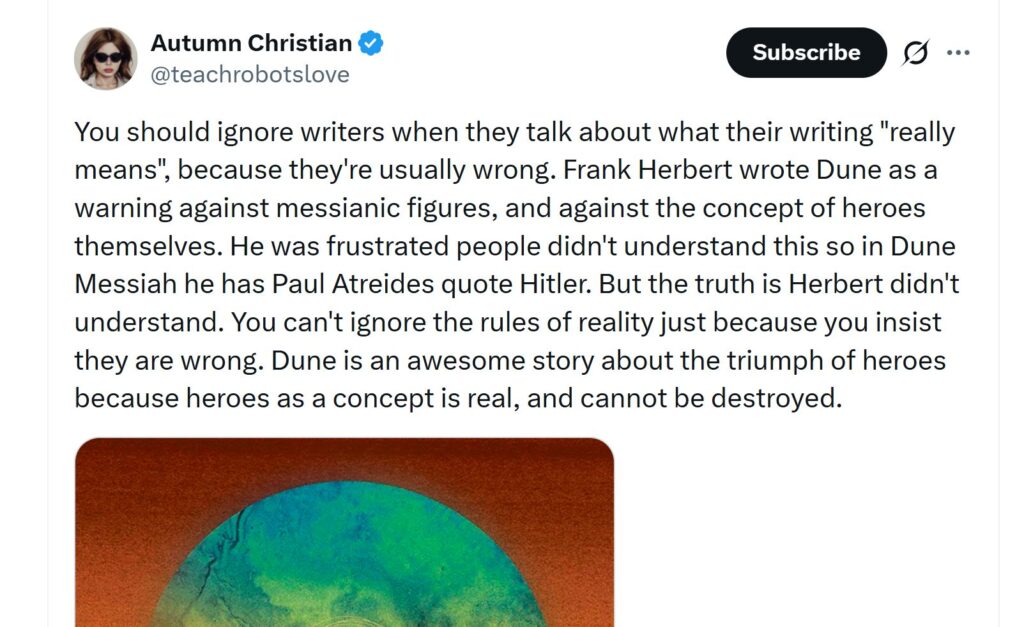
Recently on X, author Autumn Christian noted how Frank Herbert, author of the Dune saga, was frustrated that his readers did not understand the series’ message.
Read more…
Frank Herbert often corrected the prevailing interpretation of Dune as an heroic, space-fantasy epic. Instead, Herbert stressed that it was a cautionary tale against charismatic leaders. But while Herbert intended his series as a check against charismatic leaders and “messianic figures,” Paul Atreides, the protagonist, is commonly seen as a reluctant, but heroic leader. He is not the villain of the story. In fact, as Christian summarizes, “Dune is an awesome story about the triumph of heroes.”
Of course, sequels in the Dune series further develop Herbert’s anti-hero motif. This, however, does not prevent many fans from still seeing Paul as “a tragic hero, but a hero through and through.”
Which is why Christian concludes, “You can’t ignore the rules of reality just because you insist they are wrong.” And in the case of Dune, the “reality” is that the lead character is far more hero, than villain.
Cockburn and Herbert’s pushback illustrates a rather common artistic pitfall. Despite an author’s objection, Truth will always out itself.
This is especially true of heroes and the heroic.
In their essay on The Matrix trilogy, Christian Research Institute (CRI) explores the prevalence of a ‘universal heroic journey’ in myth and storytelling.
Mythologist Joseph Campbell sought to bring to light what he called the ‘monomyth,’ the universal heroic journey common to all religions, which resides in the collective unconscious of humanity. The similarity of so many ideas and images in different religions is because they are ultimately diverse symbolic projections of the same physical and mental processes that are within all of us.
Campbell would go on to develop The Hero’s Journey. This is a narrative pattern first developed in his book The Hero With a Thousand Faces. Campbell identified “a universal motif of adventure and transformation that runs through virtually all of the world’s mythic traditions.”
Perhaps even more interesting is the profound occurrence of this narrative pattern in storytelling. For example, one Star Wars fan page includes a nifty chart explaining how both Star Wars and The Matrix films follow the Hero’s Journey pattern in detail. This IMDb list includes over 60 films which trace the Hero’s Journey motif — from Fight Club, to Gladiator, to Kung Fu Panda, to Avatar.
This thematic reoccurrence of a “universal heroic journey” in art and story is reflective of “the rules of reality.” One of those “rules” involves heroes and heroism. We instinctively yearn for heroes and aspire, ourselves, to be heroic. In many ways, this pining ultimately culminates in Christ. Jesus is the ultimate hero and all our aspirations to heroism coalesce in Him. (I’ve written at length about this in The Hero’s Journey as Divine Blueprint.)
The thematic reoccurrence of a “universal heroic journey” in art and story is reflective of “the rules of reality.”
The Matrix is a good example of this. CRI summarizes how Neo, the central figure in The Matrix, represents a Christ figure:
The Christ symbolism woven into the story also is obvious. Morpheus, like John the Baptist, heralds the prophesied coming of ‘the One’ (Neo), who will free people from their bondage to the Matrix. Neo is sought by the satanic gatekeeper (Agent Smith), is betrayed by a Judas (Cypher), is killed, is resurrected by the breath (a kiss) of Trinity, and ascends into the clouds as he heralds his and his followers’ intention to preach their ‘gospel’ to all creation.
However, like Frank Herbert, the Wachowskis (directors of the Matrix trilogy) inevitably deconstructed the film and their heroic character. In a brief interview, they explained,
…the first movie is sort of classical in its approach, the second movie is deconstructionist and an assault on all the things you thought to be true in the first movie…and the third movie is the most ambiguous, because it asks you to actually participate in the construction of meaning.
So rather than build upon the biblical / traditional hero motifs, the directors deconstructed them in the following films. It’s no wonder that others concluded, “the sequels pretty much destroy the idea that Neo is a messianic archetype.”
Nevertheless, the first Matrix film, and the response of its directors, remains a fine example of how authors and creatives, perhaps inadvertently, reflect the “rules of reality” and rush to deconstruct them.
Another film series that followed a similar arc was Star Wars. Not only did George Lucas incorporate thematic elements of The Hero’s Journey into the space opera, but there are numerous religious allusions in the saga. One of the most predominant allusions is its protagonist, Luke Skywalker, whom some have compared to a Christ-figure. One author writes, “it’s impossible to ignore the mythological embodiment of the story of Christ in the figure of Luke.”
Skywalker, however, nearly suffered the same fate as other heroes. The Last Jedi (episode VIII of IX) is often considered one of the worst Star Wars films ever made. There were numerous reasons why fans hated the film. One of the main reasons was that Luke was portrayed as “a jaded, pessimistic dick who want[ed] to forget about all the Jedi stuff.” Ben van Welzen writes:
Formerly an unshakable defender of goodness and hope, the Luke we see in The Last Jedi has become jaded, haggard, and cynical, isolating himself on a private island to die along with the Jedi faith. A now-infamous image sums up Luke’s transformation: after Rey (Daisy Ridley) hands Luke a lightsaber with seven movies’ worth of history and reverence, a history that resonates with the fans as much as it should with Luke, he carelessly throws it behind his back and silently trudges away.
After significant backlash by Star Wars fans, the studio hired JJ. Abrams to helm the final episode of the trilogy in hopes of correcting course. Writing for Forbes, Paul Tassi summarizes, “It isn’t just that JJ Abrams spent the entire first hour of Rise of Skywalker ‘fixing’ The Last Jedi. When you actually view the trilogy as a whole now it’s…almost not even a trilogy at all. It’s a duology… Abrams didn’t just try to correct The Last Jedi, he flat-out obliterated it.” This included Luke’s return as a Force Ghost in The Rise of Skywalker, catching the same lightsaber he’d chucked in the previous episode, saying, “A Jedi’s weapon deserves more respect.”
So despite the director’s attempt to deconstruct the undisputed hero of the series, Truth outed him. And once again, the “rules of reality” remain undefeated.
Another example of this odd little dance between authors / creatives and the “rules of reality” can be seen in Alan Moore’s classic, Watchman. The central narrator of the story is Rorschach, a socially awkward and ruthlessly fair superhero. He’s a broken man who’s been permanently warped after encountering child murder. Rorschach’s costume is black-and-white, as is his approach to life. Yet despite his flaws, Rorschach remains the most unbendingly ethical of his superhero companions.
In Reason Magazine, Brian Doherty views Rorschach as “the moral center” of the story. In Rorschach Doesn’t Shrug, Doherty describes Rorschach’s worldview this way:
There are good guys and bad guys, and the bad guys deserve to get it, good and hard. Rorschach’s mission, from which he will not diverge, is to give it to them, no matter what the demands of law, government, or social mores. He lives by his objective understanding of right and wrong.
At the story’s end — spoiler alert — upon learning of a deceptive plan to frame another superhero for mass murder, Rorschach pledges to tell the truth. He will not lie to save face. However, his unyielding commitment to justice leads to his execution… at the hands of his fellow superheroes. Or as Doherty summarizes it, Rorschach “sacrifices himself in the name of avenging the deaths of millions who he doesn’t know. He does it for another reason as well… the truth, the facts of reality.”
Because of his sacrifice and unbending integrity, Rorschach became the most popular character in Watchmen.
But apparently the author, Alan Moore, didn’t like this. Sound familiar?
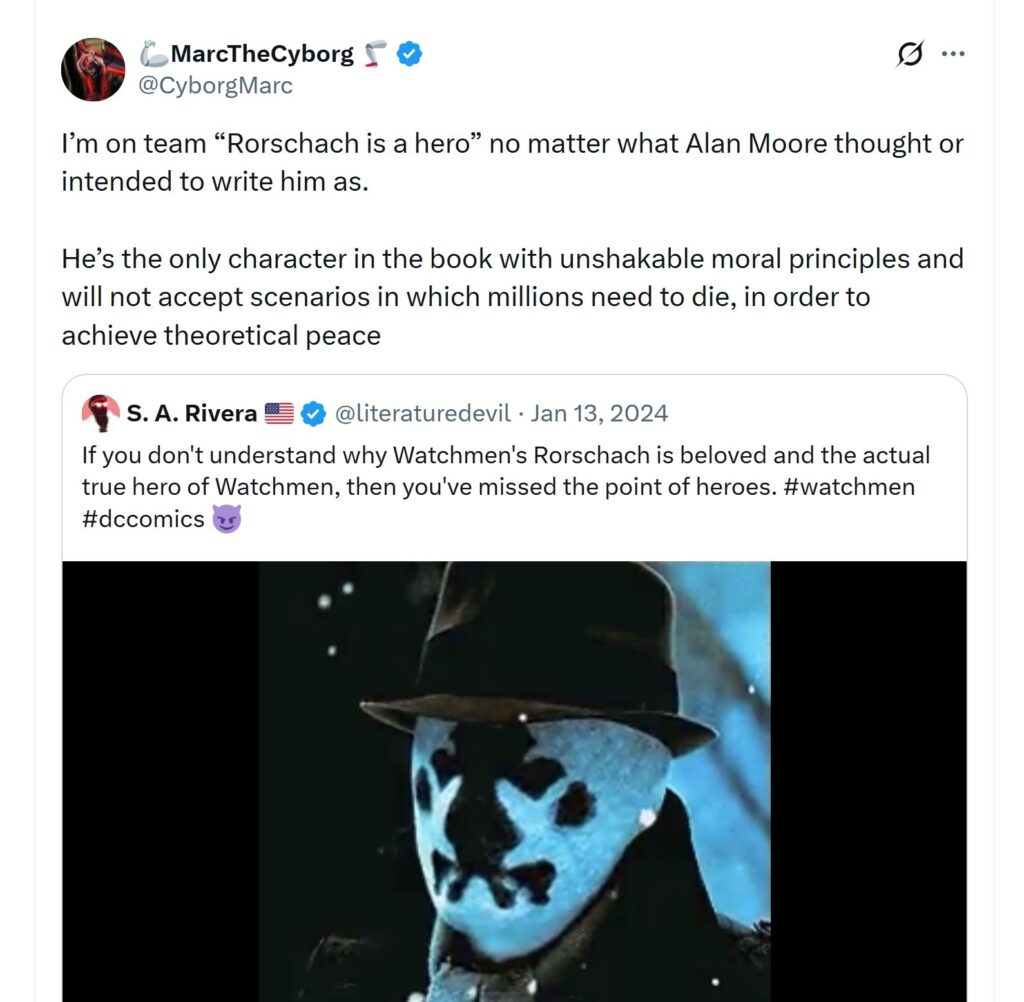
Apparently, Moore intended Rorschach to be a bad guy. But to his dismay, he became a hero to fans. In his interview with LeJorne Pindling of Street Law Productions in 2008, Moore explained, “Rorschach became the most popular character in Watchmen. I meant him to be a bad example, but I have people come up to me in the street saying, ‘I am Rorschach! That is my story!'”
But despite Alan Moore intending to make Rorschach a “bad guy,” Truth outed him. Rorschach’s “unshakeable moral principles” and willingness to sacrifice himself for truth makes him a hero, a good guy.
Sadly, this pattern is not unique to the authors and artists, songs and stories, mentioned above. There are many, many other examples. Truth exists and all good storytelling reflects that Truth… despite its author’s potential objections.
I still recall seeing the film Juno (2007) after hearing about its pro-life message. The story’s about Juno, a 16 year-old girl who, after a one-night stand, discovers that she’s pregnant. However, Juno decides to forego an abortion and give her child up for adoption. The film was enthusiastically embraced by pro-life advocates. Even the official National Right to Life page has recognized the movie for its “undeniable pro-life message.” Of course, this didn’t sit right with its creator. Diablo Cody, the screenwriter of the film, relentlessly pushed back against that interpretation. She is described as “vociferously pro-choice,” even telling The Hollywood Reporter that “she was horrified when her Catholic high school thanked her for writing a pro-life film.” Her response: “I was like, ‘I f***ing hate all of you.'” Over decade after the film’s release, Cody now regrets it, saying she probably wouldn’t write the film today.
But perhaps even more revealing is the statement the screenwriter made to the Hollywood Reporter saying, “My objective as an artist is to be a traitor to that [pro-life] culture, not to uplift it.”
Diablo Cody, and her relationship with her own art, is a painful reminder of an important precept — We can’t ignore the “rules of reality.” The fact that an audience sees the Truth behind a certain film, book, or song, only pains those who live in denial of that Truth. Authors who “leave the interpretation up to the reader” often betray their intentions when they object to a given interpretation. If the truth resides in ANY interpretation, then ALL interpretations are valid. However, such an approach denies the “rules of reality.” The reality behind Juno is that abortion ends a human life. Thus, giving a child up for adoption, rather than aborting it, is the right thing to do. Sadly, Diablo Cody, and many other artists, seems less concerned with what is right and true, than she does producing agenda-driven content.
Dallas Willard said, “Truth reveals reality, and reality can be described as what we humans run into when we are wrong, a collision in which we always lose.” The “rules of reality” will always win. Even when the author denies that reality. Truth will always out itself… no matter what the author’s intends.


I’m looking at it differently, because I don’t think the truth has a direct bearing on what an author is saying. An author can depict something outlandish, like communism working for everyone instead of the murderous elite, which is always false, but that doesn’t change what the author’s intent is. There are two different things at play here. It doesn’t mean the communism-loving author is incorrect about his intentions; he literally can’t be wrong in his intentions (though he can lie), but he can be incorrect in what his intentions are. The fact that, in the Dune example, people interpreted Paul’s character differently is filling in spaces that Herbert left open, because it wasn’t his intention to communicate what others are inferring.