
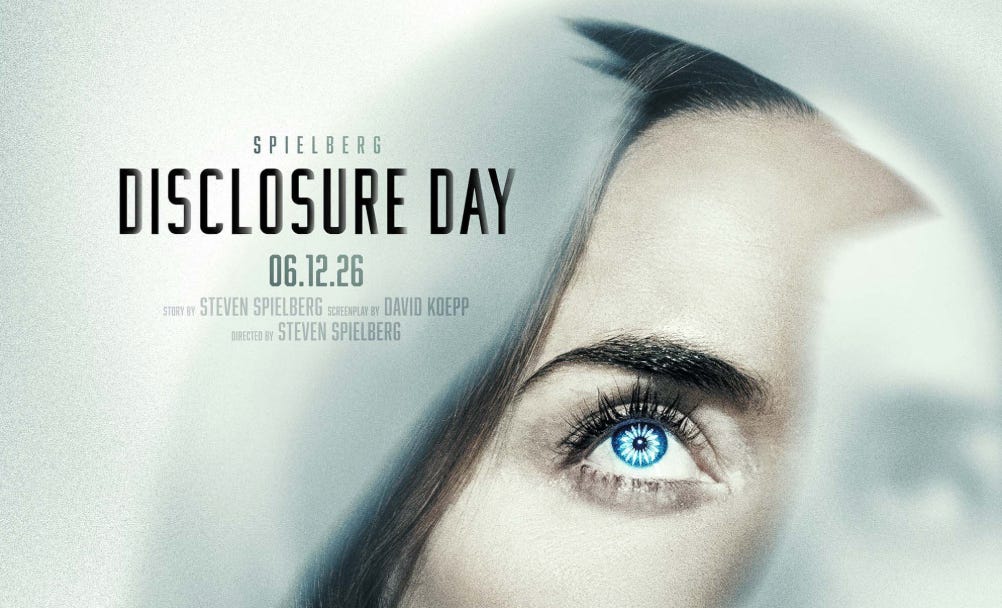
Warning: This article contains minor spoilers for ‘Disclosure Day’
The word ’empathy’ is having a moment.
Google Books Ngram Viewer reveals that use of the word “empathy” has more than quintupled since 2020. While the upsurge in use of the word has numerous possible social and psychological explanations, its ubiquity is inarguable. Teachers are now taught how to build empathy in their students while employers learn that empathy is an essential leadership skill . Empathy is viewed as good for your health and good for your business. There are now entire institutes for empathy research, with some even considering empathy as the only thing which can change our world. Which has led some to conclude that empathy might be the most overused word in the English language.
Perhaps it’s no surprise then that empathy plays such a big part in Steven Spielberg’s latest film, Disclosure Day. Neither is it surprising that the ability is framed as salvific.
Spielberg conveniently ruffled some feathers before the film’s release by suggesting that its subject could actually challenge viewers’ belief in Christianity. One reviewer writes, “While the movie centers on humanity confronting evidence of alien life, Spielberg has suggested that its most provocative questions may have less to do with science and more to do with faith. In fact, the legendary filmmaker believes the film could leave some viewers questioning long-held assumptions about religion and humanity’s place in the universe.” Though Spielberg’s original remarks did not specify Christianity, some went so far as to suggest that Spielberg’s new film might spark fresh fear over the Christian Faith.
However, the “fresh fears” and “fury” some predicted from Christians never really materialized. Nor did the mass exodus from the faith. In fact, some reported that religious leaders were “surprisingly chill about aliens.” Christian podcaster Josh Daws wrote on his X account, “Hollywood is obsessed with the idea that the discovery of aliens will rock Christian faith,” adding “No it won’t.” Eric Sammons, editor-in-chief of Crisis Magazine wrote, “The only people who think the existence of aliens would mess with Christianity are non-Christians who don’t understand the first thing about Christianity.” Turns out, Christians like C.S. Lewis, Michael Heiser, and others have been noodling about the subject for quite some time.
So while Disclosure Day appears unlikely to rock many a Christian’s faith, its religious messaging is still very much worth worth interrogation.
And there are many religious references in the movie. Nuns, crucifixes, Bible quotes, theological discussions, and stigmata all make appearances. In fact, one reviewer described the film as an “exploration of theological beliefs and biblical imagery.” However, at the center of the film’s religious messaging are the missionaries who deliver it.
In her review, Bethel McGrew notes another one of the movie’s many religious references.
Spielberg has teased a scene in the new film where a character tells us she was “raised to believe in a Supreme Being” and is now awed at the prospect of seeing “actual supreme beings.” “The world can’t handle both,” she asserts.
Of course, the “supreme beings” referenced by this character happen to be of the extra-terrestrial variety. In fact, the “disclosure” of said extraterrestrials is the revelation Spielberg’s film is steering us towards.

This isn’t the first time Spielberg has synthesized religion and UFOlogy. Nor is it the first time the director has cast non-terrestrial visitors as messianic. Both Close Encounters of the Third Kind and ET: The Extraterrestrial are riddled with similar religious imagery. The former film’s climax occurs on a Sinai-esque mountaintop as thunderous, fiery interstellar crafts descend to awestruck witnesses who greet wise, benevolent, glowing non-human entities who will whisk their devotees to the stars. ET is even more forthright. As the earthbound alien seeks to return to the heavens, he assembles a ragtag group of followers, is captured by authorities, dies, is raised from the dead, and then ascends back to the heavens. But not before telling them to “be good” and then promising them he will always be present with them (“I’ll be right here”).
Not coincidentally, the “supreme beings” of Disclosure Day also have a message. That message is “have empathy.”
Some have described the film as a tour de force of freaky empathy. Or as Trisha Bhattacharya summarizes in Disclosure Day makes empathy more powerful than any alien revelation:
…it is a film about empathy. More specifically, it is a film about listening.
The film repeatedly shows that understanding another person can be just as powerful as any scientific discovery. That message runs through the entire story.
…before we can understand beings from another world, are we capable of understanding each other?
According to Disclosure Day, the answer begins with empathy.
And empathy begins with listening.
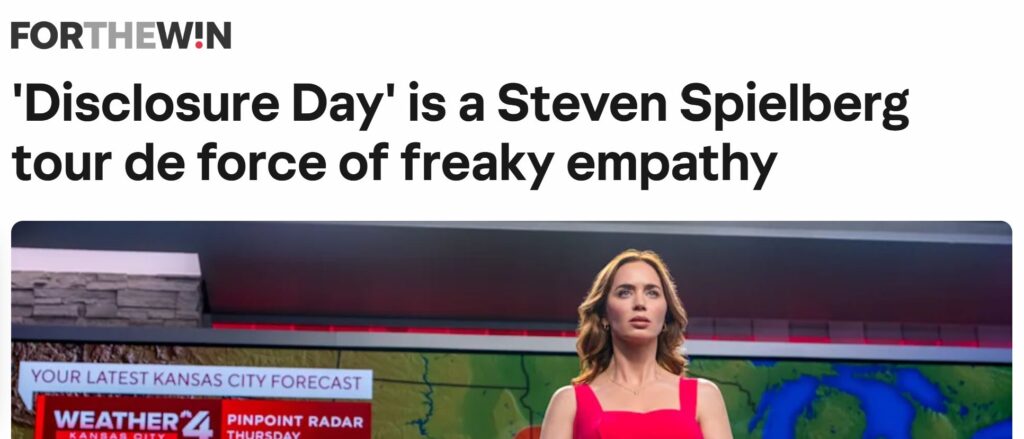
This reviewer distills the entire film into “an examination of empathy.”
The message about aliens—the unknown—and how humans approach everything that isn’t familiar to them is a cautionary tale about how much darker our world will become if we don’t start accepting that none of us are better or superior because of our race, ethnicity, gender, sexual orientation, etc. And yet, that’s a big thing to ask from the world. It’s too much. Almost every movie and TV show is attempting to do so right now because that’s how desperate we are for basic human kindness. Empathy.
Similarly, Cory Woodroof gushes,
Disclosure Day posits that empathy isn’t just a nice sentiment; it’s a celestial practicality, an evolutionary advantage to withstanding extinction.
Woodruff goes on to describe empathy as far more than just an ability or an emotion — it is a “righteous bridge to the new world.” In fact, in his interview with Stephen Colbert for the film’s release, the director described empathy as “the ultimate superpower.”
Clearly, empathy is an unparalleled force for some. It’s “as powerful as any scientific discovery,” a “celestial practicality” which gives us “an evolutionary advantage,” a “righteous bridge to a new world.” Indeed, empathy is our “ultimate superpower”!
And this is exactly where Spielberg’s alien gospel and biblical Christianity bump heads.
Writing for the Gospel Coalition, Brett McCracken summarizes,
Disclosure Day is a sincere and hopeful film, but what’s the source of that hope? Does humanity have the capacity to overcome its divisions and misunderstandings if it just prioritizes empathy enough? If that’s Spielberg’s hope, it feels naive.
In their piece, Can Aliens Save Us, Christian thinktank Theos concludes,
Empathy is certainly not a bad thing… But empathy alone is a very thin gospel. It does not tell us what is true. It does not tell us what is good. It does not tell us how to order our loves, forgive our enemies, restrain our desires, or face death. It is a good feeling more of us should feel, but not a panacaea.
In the most basic sense, empathy is simply an action or ability to understand, be aware of, be sensitive to, and vicariously experience the feelings, thoughts, and experiences of someone else. This is a good thing. However, empathy, like other virtues, must be grounded in what is right and good. If not, it can enable destructive behaviors and make others vulnerable to exploitation.
Even worse, unchecked empathy can lead to the embrace of deceptive, unbiblical messaging.
The ‘gospel of empathy’ is one such message.
Perhaps this is why Rod Dreher described Disclosure Day as both “profoundly religious” and “profoundly evil.” He concludes,
…parents, priests, pastors, religious leaders all need to see Disclosure Day. It is a fairy-tale of re-enchantment for a Gnostic, occultic, scientific-technological era. Whatever Spielberg’s limitations as a storyteller in this film, he has produced a near-perfect example of the kind of false and deceptive story that we will all be led to believe in the Age of Antichrist. We have to have strong, well-informed answers to counter these stories, so we and the people who depend on us for leadership will not be deceived.
While Spielberg’s warnings that his latest film could create “ontological shock [and] social dislocation” among Christians is clearly overreach, the film’s messaging deserves a critical side-eye. To which Randall E. King, writing for World concludes, “The great director’s latest alien film is a good movie but a bad sermon.”
In this sense, the possibility of non-human lifeforms is not nearly as problematic to Christians as the message those alien life-forms might bring. And in the case of Disclosure Day, the gospel of empathy is a weak substitute for the Gospel of Jesus Christ.








Christians have skepticism fatigue: we’ve heard every form of all the gotcha questions and responded to them ad nauseum. At this point, skeptics can just ask AI what their problem is and get a imperfect but decent answer. Overeager materialists are just trying to get negstivr reactions and it’s not really working anymore.
Modern US Christians of the more conservative persuasion seem to have two things in common: they don’t think aliens are visiting this planet (unless they’re demons) and they don’t trust empathy, mostly because that word has been used quite a bit by their political foes. Even beyond current usage, for the past 70 years, there have been those within the Church who have decried the “Social Gospel,” the idea of ministering the Gospel by meeting people’s needs.
The history of Christian exotheology suggests that we can certainly prevail in the face of the confirmation extraterrestrial life, if that ever happens. But we’ve been trained by the Satanic Panic and the “discernment ministries” which followed their traditions within the fundamentalist, charismatic and evangelical branches of Christendom to be wary of future alien gospels. Why? Because some UFO-related cults and a handful of people who claim an alleged abduction experience (only about 10% of experiencers claim they’ve been given some kind of message) have either related syncretic religious messages that compromise Christian doctrines or anti-Christian messages. It should be noted that some come back with alleged messages affirming Judeo-Christian doctrine and Jesus’ deity.
It’s worth noting that Discosure Day, ETI message of empathy and all, is fiction. As such, it’s helpful to regard Spielberg’s remarks about Christianity’s response to his film’s message not as ontological shock regarding the existence of “supreme beings” from space (neither EBEs –extraterrestial biological entities — nor AI beings qualify as “supreme beings” on the level of God; the old adage, ‘If it can bleed, it can die’ applies here) but as a charge of gross hypocrisy against Christianity. Jesus said we would be known as His disciples not for our political affiliations or doctrinal statements, but by our love. He emphasized love for both our neighnors and our enemies. His criteria for being greeted with ‘Well done, thou good and faithful servant’ versus ‘Depart from me, you workers of iniquity’ was whether we ministered to those who were hungry or thirsty or sick, needed clothing or shelter, were immigrants or in prison, and all that. The very things Jesus did that made the masses willing to listen to His message.
We’re commanded to speak the truth ..in love. And we often fail at that. In Spielberg’s eyes, it seems we have forgotten it so much that he feels the need to send aliens as missionaries to remind us we’ve abandoned the very thing that was meant to identify us as Jesus’ disciples. We’re very concerned with being right–So much so that we are suspicious of a message of empathy–but that used to simply mean an attitude of “There but by the grace of God go I.”
Is faith without works not still dead?