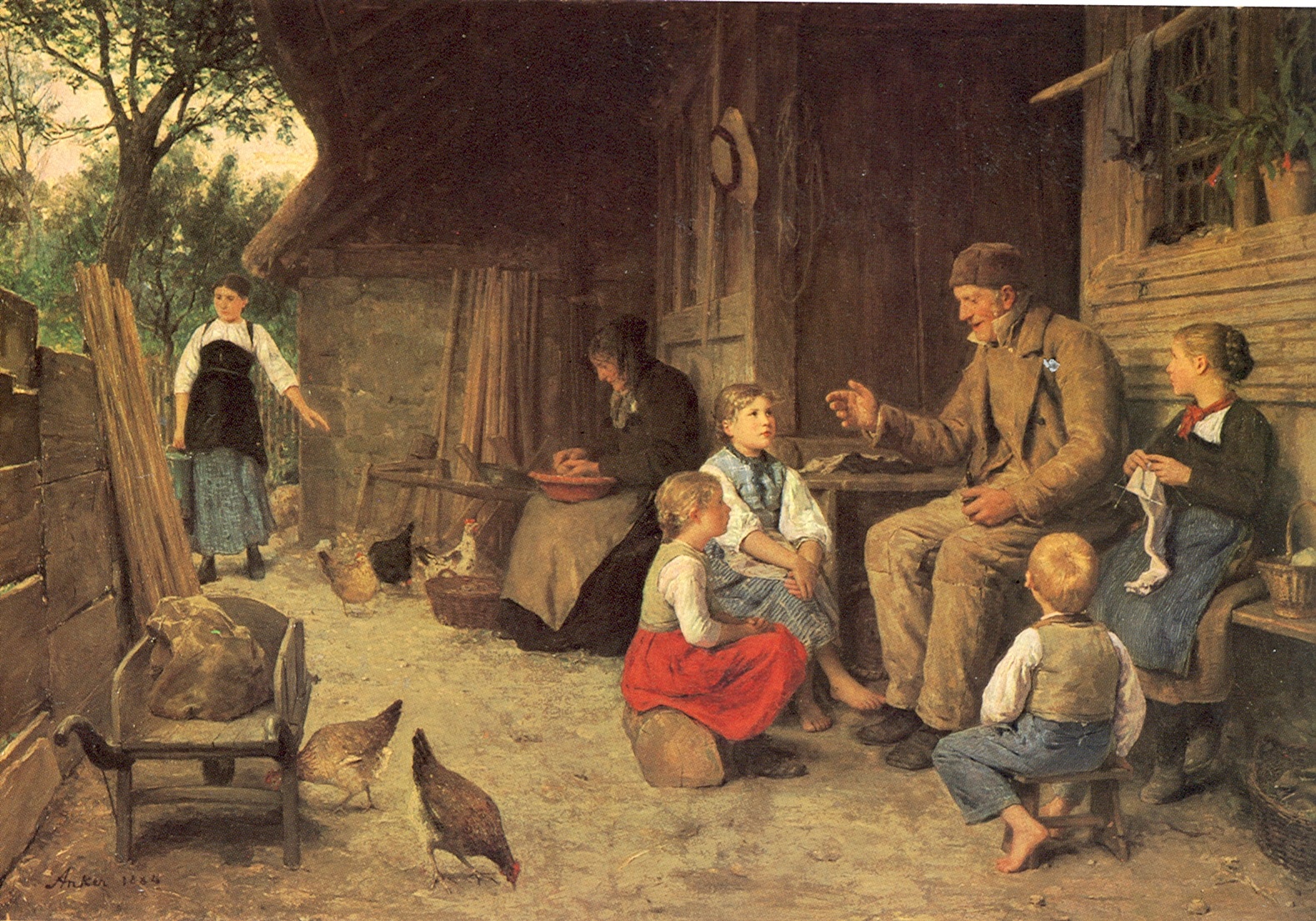
Grandfather Telling a Story, Albert Anker, 1884
2026’s mid-term elections are being called a bloodbath, a blue tsunami, and a political rout. With Democrats taking control of both the House and the Senate, Republicans are left to ask what happened and how they can regroup.
But I doubt that the art of storytelling will receive much consideration.
Truth is, we’ve been here before. After Barack Obama was re-elected to the presidency in 2012, many conservatives worried over the results, what they meant, and possible course corrections.
Interestingly, some even asked whether or not political conservatives needed to re-learn the art of storytelling.
In After the Crack-Up, Lee Habeeb placed the blame for Republicans poor showing in the 2012 election not on politicians, pundits, or pollsters, but on conservatives’ “profound storytelling deficit.” He wrote:
…if there is one thing conservatives can agree on post-election, it’s this: The dominance of the Left in the storytelling arena is making a difference at the polls. It’s impossible to measure, but anyone who doesn’t think it skews outcomes is living in an alternative universe.
The fact is, it’s easier to sell a political narrative to America when it comports with the cultural narrative we see and hear every day. (bold mine)
Andrew Breitbart famously popularized the idea that politics is downstream from culture. If this is true, then winning elections requires winning the culture. When an individual, an industry, or a party, represents or controls “the cultural narrative,” winning elections is a given.
Habeeb concluded,
…the Left understands the importance of storytelling and dominates almost every aspect of it in the culture, from content creation to distribution. Regrettably, too few conservatives think storytelling matters.
We’ve invested billions in our great think tanks but little in the task of translating that work into stories the average American will care about. Yes, we have Fox News and political talk radio — important outlets, but outlets that narrowcast to the conservative base and are driven by politics and opinion, not storytelling. (bold mine)
Obama’s re-election evoked much consternation amongst conservatives. The L.A. Times noted that some called it the “Disaster of 2012,” a “devastating rebuke,” and the “Death rattle of the establishment GOP.”
However, that was 14 years ago! Surely political conservatives have advanced in their savvy and cultural influence.
Spencer Pratt doesn’t think so.
After losing his home in the January 2025 Pacific Palisades’ wildfires, Pratt became a vocal critic of L.A. city leadership, particularly Mayor Karen Bass. He announced a run for L.A. mayor in January 2026 and lost under incredibly suspicious circumstances when “progressive councilwoman Nithya Raman surged in the 11th hour” to oust Pratt and secure 2nd place. (Uncoincidentally, Raman is currently projected to win L.A.’s 2026 mayoral race.)
Shortly after the 2026 Republican “bloodbath,” Pratt suggested that “good storytellers” and “telling a good story” is the key to influencing culture and politics. In his lengthy tweet just two days after the election, he wrote,
If you think that high prices lost the election for the right, you don’t understand marketing. Humans have no problem paying a premium for a good quality brand. Notice the word “brand”, not “product”. Are Nikes better than New Balance? Nope. But the brand is better. And notice what happened when they tinkered with the brand and screwed their core narrative? Nike stock fell through the basement. Did the product change? Nope. The brand did.
It’s not the product, it’s the brand. Results don’t sell the product, the storytelling does. Will these newly-elected commies lower prices? Of course not. Are they gonna get you free healthcare? No, your insurance is gonna get even worse, just like it did the last time they tried socialized medicine. They’re not going to do anything they’ve sold you, but…like Saul Goodman said: if you’re committed enough, you can make any story work.
Saul Goodman is a fictional character in Better Call Saul and Breaking Bad. He’s an unscrupulous Albuquerque lawyer and a con artist who becomes involved in the city’s criminal underworld. In his tweet, Pratt included a clip of Goodman telling Walter White (Breaking Bad antihero) that it doesn’t matter how crazy a story is, because “if you’re committed enough, you can make any story work.”
Pratt concludes that even though the political Left offers crazy stories (i.e., men can become women, infanticide should be legal, men should be allowed to compete in women’s sports, socialism / communism hasn’t really been tried yet)…
…they’re good storytellers, and that’s all that matters. Are they telling a good story? No, it’s atrocious, but they’re telling their atrocious story effectively and compellingly.
In between these two elections, conservatives have, indeed, made inroads into the arts. Between Angel Studios‘ growing canon of films and the Daily Wire’s Pendragon Cycle: The Rise of the Merlin, we’re definitely seeing increased interest in storytelling among conservatives.
But if this recent election reveals anything, it’s that we have a long way to go.
Truth is, progressives have long realized the importance of art in shaping culture. And they have a big head start.
In his article on German philosopher and sociologist Hebert Marcuse entitled The Illusionist, Robin Phillips discussed the profound effect Marcuse’s theories have had on shaping American thought. Marcuse was part of a unique intellectual vision that came to be known as “the Frankfurt school.” The adherents were disillusioned with traditional Western society and values, believing that Western Civilization was something we needed saved from. Phillips summarized the vision of the Frankfurt School thus:
That vision was essentially Marxist, but with a twist. Whereas Marx believed that power rested with those who controlled the means of production, the Frankfurt school argued that power rested with those who controlled the institutions of culture. The school would come to include sociologists, art critics, psychologists, philosophers, “sexologists,” political scientists, and a host of other “experts” intent on converting Marxism from a strictly economic theory into a cultural reality. (emphasis mine)
The Frankfurt School inevitably came to the United States where its vision was progressively embraced by American academia. Thus began the “sabotaging” of American ideals, the deconstruction and revision of commonplace terminology, an appeal to youth (Marcuse was an intellectual guru of the 60’s counter-culture who invented the catchphrase “Make love, not war,”) and the slow takeover of “institutions of culture.” Ever wonder why the mainstream media, the arts, the entertainment industry, the halls of academia, major news outlets, and our youth culture primarily lean Left? Well, it didn’t happen overnight.
Which is why, on the eve of this most recent political “bloodbath,” it is worthwhile to consider the role that storytelling plays in conservative politics. And culture. As much as we may be seeing advances in the arts, both political and religious conservatives still suffer from a “profound storytelling deficit.”
Which is why Pratt concludes,
It’s not the product, it’s the brand. A great product can fall into oblivion with bad messaging…a single bad review from one effective storyteller can tank a restaurant. The “influencer economy” is lucrative for a reason; everybody inherently understands the importance of effective storytelling…except the right.
Perhaps, then, the real culture war is not between liberal and conservative ideals, but between conservatives who value the power of story and cultivate good storytelling and good storytellers. And those who don’t.