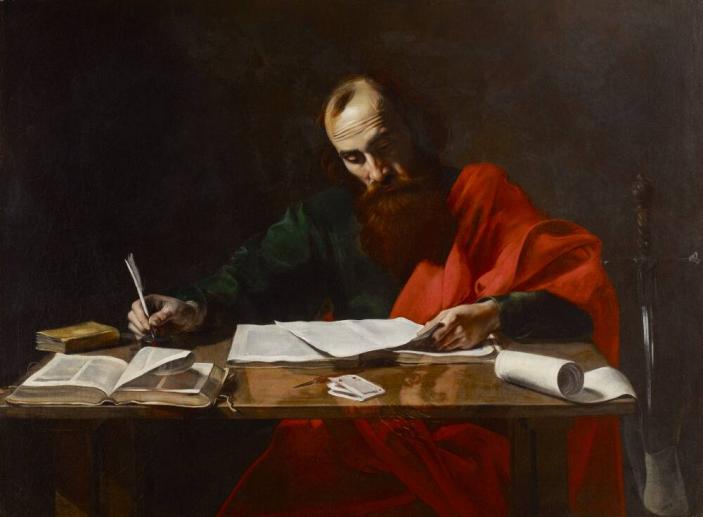
Saint Paul Writing His Epistles, French, c. 1618-20
Nadine Brandes, a prominent Christian fiction author, recently posted a compelling piece on her Substack page entitled An Open Letter to Christians Against A.I. The gist of the piece is that, in opposing AI in art, we shouldn’t lose our own humanity, become “self-righteous,” and conduct witch hunts against others. She writes,
Our focus must be on Christ. On Who we’re fighting for instead of what we’re fighting against. Otherwise, we risk making our own ‘noble battle’ our new god.
It’s a great point and one that every Christian author should consider.
The problem is there’s a fine line between opposing AI technology and the people who use it.
To be clear, most people understand that there’s a fundamental difference between using AI to research or aggregate material (Assistive AI) and using it to generate content (Generative AI). The majority of the AI debate centers not in the use of Assistive AI for writing novels, but the use of Generative AI to create content (which the “author” then edits).
It’s important to note that opponents of AI seldom challenge the value of Assistive AI.
Podcaster and Christian author Laura Wifler recently surveyed Christian publishers about the use of AI. According to her research (a relatively small sample size), Christian publishers view AI use for research as “generally acceptable.” Generative AI is another story. She writes,
Across conversations, the most consistent line in the sand was: using AI to generate manuscript text is a near-universal no. The manuscript is meant to reveal your voice, your thinking, your ability to craft, and your readiness. It’s a major piece of what publishers are buying (the other piece is YOU). Across the board, all pros are fine with using it as a thesaurus or rhyming tool (the same kind you can get all over the internet), but beyond helping you find a single word, nearly everyone is against using AI on your manuscript.
The idea that “the manuscript is meant to reveal your voice, your thinking, your ability to craft, and your readiness” is central to the Christian objection to AI.
For example, biblical apologist and professor, Douglas Groothuis, suggests that Christians should develop “a robust theology concerning AI.” In his essay, AI and the Eclipse of the Author: The Image of God and Biblical Ethics, Groothuis suggests that God’s very nature “grounds the metaphysics and morality of authorship.”
Our ability to write is rooted in our being made in God’s image; it flows from our consciousness, rationality, agency, and creativity in God’s world. As such, it is a gift to be stewarded wisely and one to be protected from corruption by proper ethics.
Which is why, according to Groothuis, using AI is a kind of “literary suicide.”
When you affix your name to a written work, you claim authorship — intellectual ownership and accountability. When you plagiarize or use AI in writing, you attribute knowledge and skill to yourself that you do not possess. That is a lie. You become a literary pretender. This is akin to someone claiming to compose music he or she did not compose… you deny yourself true authorship for the sake of faux authorship, which is a kind of literary suicide.
A similar line of reasoning is behind the recent renunciations against preachers using AI to craft their sermons. In a 39-page guide titled The Work of Our Hands: Christian Ministry in the Age of Artificial Intelligence, the Ethics and Religious Liberty Commission (ERLC) of the Southern Baptist Convention issued a strong caution to church leaders about the growing influence of artificial intelligence in ministry.
AI can assist the pastor in preparation, but it should never be used to replace or substitute for the distinct calling upon the man of God to preach God’s Word to God’s people.
The authors’ warn that bypassing the work of personal study, Divine inspiration, and prayer strips sermons of their spiritual depth, authenticity, and humanity.
The same is true of the author who relies on AI-generative stories. Rather than reflecting the Imago Dei, they subvert the creativity, consciousness, agency, and imagination of their Creator for non-human mimicry.
In her Substack piece, Brandes acknowledges that “AI has wronged us all.” (Like when I learned that six of my books were used by Meta in a pirated database to train its AI without permission or compensation.) If this is so, then anger is understandable. Of course, resorting to hate-mongering or slander is definitely an inappropriate response from believers.
But opposition is not.
In fact, loving the AI author means challenging that author’s use of AI generated content.
I recently read about novelist Coral Hart. Using Anthropic’s Claude AI, Hart produced over 200 romance novels in a single year and, using 21 different pen names, published them to Amazon. While none of the novels were huge hits, they cumulatively sold around 50,000 copies, bringing in six figures. The author boasted that using AI, she is able to churn out a new book every 45 minutes. She told the New York Times:
If I can generate a book in a day, and you need six months to write a book, who’s going to win the race?
Though an obviously extreme example, Coral Hart is just one of many authors now cranking out content and attaching their names to novels written by artificial intelligence.
Question: How do Christian authors love Coral Hart? By buying her books? By applauding her innovation and ingenuity? By encouraging other authors to follow her lead? Or by simply shutting up?
And therein lies the rub. For by choosing to speak up, you inevitably run the risk of being labelled a hater.
In addressing the AI controversy, both Nadine Brandes and Doug Groothuis implore the Christian to not lose their humanity. Their appeals are two prongs of the same objective. When opposing AI, we sacrifice our humanity by giving in to hatred and slander. Becoming ungracious, legalistic witch hunters is not the way of Christ. We also sacrifice our humanity by signing our name to content we did not create, and by remaining indifferent about those who do.
Yes, the AI debate is complicated and nuanced. Navigating that debate will become increasingly important for writers. As Christians, we must extend kindness and charity to everyone, no matter where they stand. But in some cases, challenging an author’s use of AI generated content may be the most loving thing we can do.